Friends and colleagues, here we are: two days after a stunning rebuke of the President’s agenda across the board.
You’d be forgiven for feeling some serious whiplash on the politics of “immigration” in America. On other major issues dominating this midterm, voters actually remained relatively consistent in their policy demands from 2024, even as they opted for new political leadership: no foreign wars, swamp draining, and (above all) relief from the affordability crisis. On “immigration,” it wasn't the President who failed to deliver on a promised agenda, but voters who sharply changed their demands when that promise played out in front of them.
I want to break down this short and trauma-packed political history because understanding it and the lessons it holds is essential to getting the next part right. The next part being: what do Democrats do on immigration policy with more governing power, especially as they reckon with the harmful enforcement infrastructure already built, dirty dollars already out the door, a colossal undoing of rights and protections, and this administration still in power.
Let's back up:
Democrats began this presidency at a substantial deficit and a political “hangover” on the issue of immigration
You haven’t remembered it wrong. Voters in the 2024 election were deeply unhappy about immigration and at what they saw from the last administration on the issue: the failure to make decisions about and continued chaos at the border (particularly between ports of entry), the lack of a clear plan for how to address new arrivals in a handful of blue state cities (exacerbated by politically opportunistic GOP governors busing even more new arrivals to those handful of cities) and, of course, the failure to put forth a clear policy agenda that prioritized permanent legal status for immigrants who had been building their lives here for decades.
Then, like today, concern about the cost of living and the failure of leaders to address it blotted out the political sun, but immigration hung just a few rungs down in salience. And, in 2024, voters told pollsters that they consistently and overwhelmingly preferred President Trump on “immigration” to President Biden and then Vice President Harris, and swing voters disapproved of President Biden’s handling of immigration by as much as a 4:1 margin.
Ultimately, President Trump returned to the White House claiming a mandate for an all-of-government approach to his “Mass Deportations Now” promise.
Many political prognosticators told Democrats not to confront the President-elect on “immigration” despite his promises to purge America of 10 or 20 million people and eviscerate basic Constitutional protections like due process, Birthright Citizenship, and habeas corpus. He promised to revoke work authorization and legal status for millions of immigrants – including Dreamers, those who fled the Taliban and those who have built lives here for a quarter century – and rip away their access to housing, bank accounts, education, and driver’s licenses, while at the same time advancing an unprecedented expansion of the infrastructure to arrest, jail, and deport millions.
2025 began. The Laken Riley Act – one of the most harmful federal criminal justice and immigration enforcement bills to pass in decades – swept so quickly through Congress with bipartisan support that there was hardly time for media coverage to catch up to how it would work.
And as Republicans in Congress began their months-long effort culminating in the party-line reconciliation OBBBA bill, which cut a shocking $1 trillion from health care and more than tripled ICE’s budgets through 2029, the consensus messaging guidance was to avoid focusing on the ICE dollars when speaking out in opposition to the larger funding bill. (I’ll come back to this bill later, don’t worry).
As the administration rolled out its cruel agenda, public outrage grew and Democrats started to come off the bench
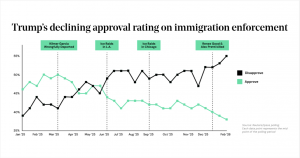
As the President’s immigration enforcement agenda played out in public view in the spring of 2025, things began to change. First came public alarm about the disappearances to CECOT, the use of the Alien Enemies Act, and government lies about hair dressers and “gang members” with (autism awareness) tattoos. The administration tore through norms, including labeling these and other immigrants “terrorists” and “national security threats” and invoking war powers. That a small number of individuals and elected officials travelled there to raise public awareness and demand their release was critical. The President’s approval on this issue took a big hit.
Then the federalized deployments began – an intentionally high-profile torrent of chaos and violence from ICE, CBP, and other federalized law enforcement designed to shock first Los Angeles and then Washington, D.C., Charlotte, Chicago, and elsewhere. Militarized teams raided Home Depots, showed up outside political redistricting announcements, and descended from military helicopters into apartment buildings. In response, parents organized carpools and school escorts to get immigrant kids safely to school. And public officials started to join in: locking arms and forming a united front to fight back, and public opinion moved. None of this came without a cost: funding was withheld, congressional candidates were charged with obstructing ICE, and a congresswoman to this day faces up to 17 years in prison for engaging in basic oversight duties.
So how do we reconcile President Trump’s mandate on “immigration” in 2024 with voter rejection just months later? Capriciousness? I don’t think so. I think while there were those of us talking very literally about the explicit and cruel immigration enforcement playbook the Trump campaign proposed in 2024, it’s possible many of his voters were demanding that something be done and that their concerns be taken seriously without tracking or believing what the President had planned. And “immigration” isn’t one thing, of course (surprise: that's why I’ve been using quotation marks), and as voters' primary attention shifted away from the border to what played out across the country in 2025, attitudes shifted.
By the end of 2025, the public was turning fast. Democrats were off the bench, confronting some of the most egregious, visible overreaches.
After heartbreak in Minneapolis, Democrats stood firm on the truth: gutting healthcare to fund brutality is wrong, and enough is enough
Then the President deployed thousands of federal agents to Minneapolis to target Somali refugee and immigrant communities and those around them. The barbaric tactics deployed were designed to provoke a community response. They were supposed to act as a reason and mechanism for breaking down basic democratic norms. Instead, the people of Minneapolis showed up for their neighbors, and DHS responded with more violence, and subsequently killed Renee Good and Alex Pretti.
Those in Minneapolis demanded ICE immediately withdraw, and national Democrats had a choice on how to respond, especially given there was a pending DHS funding bill that would give tens of billions more on top of the $191 billion already secured through the party-line reconciliation. While some wanted discrete ICE reforms, others pointed out that unmasking officers or adding body cameras (where the evidence base has long been shaky) to a superfunded, shameless, and unaccountable agency would have limited effect.
With smart organizing, Congressional Democrats moved the primary position from "reign in ICE with reforms" to “ICE and DHS already have hundreds of billions to terrorize communities and those funds were cut from your health care.” Democrats held the line on additional funding.
This big, uniting message was the most salient one and the one that could hold the largest coalition because it both told the truth about the harms of immigration enforcement and about the trade-offs the American public was being forced to swallow to pay for it. Instead of “should we run on ICE or affordability?” The opportunity was to tie the two very truthfully together. Everyone from progressive House Members to moderate Senators coalesced around this message. It resonated with voters angry at a President focused on the wrong priorities, and it was a solution sized up to the scale of the problem.
And it worked! Paired with historic local activism and regular people staring down state violence, ICE withdrew from Minneapolis. When the President threatened and even tried to shut down airports, Democrats held strong. For months and months. President Trump’s political power on immigration was substantially reduced. When the ICE and CBP funding finally passed, it did so without a single Democratic vote.
Candidates ran on the message and won primaries and brought it to the general election. It's been adopted as a core message from the left to the center. Disapproval for ICE climbed to historic levels – where it remains today.
This week’s election results are an overwhelming repudiation of the President’s agenda – including, in no small way, on ICE and immigration
And now it’s a wipeout. The President managed to systematically alienate big, different, and important parts of the coalition he collected to win: voters expecting swamp-draining or no more foreign wars, voters of all kinds who were angry at failed promises to address the cost of living. And voters livid about ICE.
Was ICE the top issue for every voter or the most salient issue in every race? Nope. Did poll after poll identify immigration enforcement as one of the top 3-5 motivating issues and a primary one that drove substantial defections from the President and motivated people to turn out? Absolutely.
In particular, we found in our own polling, and elsewhere, that it was the criminalizing tactics – the violence people saw in their communities and on their phones, the arrests, the deportations and the promises to drastically expand this infrastructure – from which people revolted the most. Democrats went on offense on immigration and were able to clearly show that the President was focused on the wrong priorities, highlighting how the President was financing a supercharged ICE to terrorize communities with massive cuts to health care.
In past jobs, I’ve worked to elect all sorts of Democrats, including in the most conservative areas of the country. Not everyone needs to always do or say the same thing. What was so important in the last year was that candidates were able to fit this overarching message into what worked for their districts, whether that meant leaning into the harms to specific immigrant communities or to local economies, the consequences of health care cuts, or as a reason why it was so important to both build a secure and orderly border and provide pathways to citizenship.
One clear midterm story: many of the voters closest to some of the administration’s worst enforcement actions, who also had swung the most to him from 2020 to 2024, came out strong, and the candidates who made clear contrasts on immigration and spoke out against the administration’s enforcement agenda were favored. Here are just a few examples:
Democrats swept every statewide office in Texas, the state with the most ICE and immigration arrests in the country, and ran up massive vote totals in the House race in the Rio Grande Valley. One of the House’s most conservative Democratic incumbents and House Majority PAC pounded away at how the administration’s ICE funding was hurting communities and driving up the cost of living. Governor-elect Hinojosa and Senator-Elect Talarico have been champions in fights to oppose state-mandated participation in 287(g) agreements, to Close Dilley, to stop efforts to eliminate immigrant children’s access to K-12 education, and to fight against individual deportations.
These trends repeated across the country. Democrats elected a Governor in Georgia, secured trifectas in Nevada, Arizona, and elsewhere, and for some more examples not to miss:
- In York, PA – which, due to its 287(g) agreement, has the highest percentage of immigration arrests in the country – Democrats flipped a House seat with immigrants rights groups organizing on the ground. Across the state in Allentown, anger from Latino voters and candidates leaning in fueled a double-digit win for another new Congressman.
- In New Jersey, the Mayor of Cape May rode to a massive congressional upset with a campaign highlighting ICE’s actions in the state.
- In Kansas, after ICE raids, both Republican Senators made a last-minute effort to distance themselves from ICE’s actions. Voters surged to the polls in the areas impacted by enforcement, citing this as a reason to elect the first Democratic Senator from Kansas in over 90 years.
- And other places where the administration focused its anti-immigrant demagoguery and intense enforcement include: Ohio, home to two-plus years of horrific attacks on Haitians, elected a Democratic Governor and Senator; and in Minnesota, where the federalized deployment was followed by investigations, attacks and the effort to prosecute and denaturalize a sitting Congresswoman, Democrats stood together, fought back, and secured a Democratic trifecta for the state.
The public has spoken: first in their actions, and then in their votes. Now it’s up to us to chart a path forward because backlash won’t be enough
Let’s sit with some hard realities: President Trump is still in charge. DHS continues to have at its disposal a never before sized war chest to draw down from and a newly deputized (and fast-growing) network of local and state law enforcement. Our refugee system now exists exclusively for white Afrikaners; we have country-based immigration bans predominantly on Black-majority nations. Official government accounts post far-right memes declaring the cause of “Remigration” a “central” and “civilization” project of our time and brag about nearly eliminating Muslim immigration, and are still promising mass deportations will fix everything in your life – from housing costs to education. The Vice President laid out as much yesterday.
Now that they have built an enormous infrastructure (thanks in large part to commandeering the too-large, notoriously biased, and harmful American criminal justice system onto the effort), we can expect their work to be more efficient, scaled up, and able to enact more harm with less visibility. In addition to criminalizing many more people and actions, they will press to cut off immigrants from basic needs – from housing to K-12 education to bank accounts.
I am an optimist, and with the right focus and hard work we can mitigate this harm – but it would be a betrayal to not see clearly what lies ahead.
So today, I humbly offer some next steps to focus our attention on the types of actions and solutions that can begin to meet the size of the moment:
1st – Democrats should begin the 120th Congress by making clear they never accepted and will never accept this level of enforcement, and vote to “claw back” the over $100 billion in unused ICE and DHS funding passed via the reconciliation bill and use those funds to restore health care cuts. And they should be ready to keep fighting as new funding requests come in from the many actors who are now materially invested in this enforcement surge. This cannot be a new baseline.
2nd – Democrats in Congress can continue to campaign against enforcement overreach, with aggressive oversight. The strategy should build on the many oversight visits over the last 18 months to courts and detention centers and must include investigations into how the administration is using federal funding to entrench harmful practices, including 287(g) agreements with state and local law enforcement, contracts both within and outside ICE, and the conversion of warehouses into detention facilities, jail and detention capacity, and private prison and surveillance contracts.
3rd – Democrats can use their new governing power at the local and state level to push back against this administration, work to hold them accountable, and highlight their harms to the public. Some examples of the many meaningful actions these policymakers can and should take: rescind and outlaw 287(g) agreements, bar information sharing, pass accountability measures against federal agents, end the use of state and local jails for immigration enforcement, reduce their own jail and prison populations, and ensure immigrants retain key protections for K-12 and higher education, housing, and driver’s licences.
4th – Democrats and pro-immigration allies – in Congress, in communities across the country, business, civic, and civil rights organizations, in group chats and everywhere – need to begin, right now, building the moral, political, economic, and policy case to bring their own all-of-government approach to an affirmative vision and policy framework for immigration that anchors a permanent pathway to citizenship.
If you’re reading this far, let me be clear: yes, we absolutely need citizenship bills next year, but what must happen is a big, consistent, inside/outside effort by all of us to create a governing moment in which we can leverage as many administrative, legislative, executive, judicial, and other policy tools to provide pathways to citizenship to undocumented immigrants and those with a temporary status who have been building their lives here. It is on all of us to make the arguments, to demand this of our candidates, and to think hard about all the ways to get this done.
All this should be part of an overall affirmative vision and policy framework for immigration. One that builds a secure, orderly approach to irregular migration and the border, treats people already here fairly, and builds a legal immigration system that allows America and Americans to thrive for decades to come.
We should be clear that this election is not a mandate for everything we might want, nor a repudiation of all of the President’s immigration policies, notably those at the border. But the campaign that meets this opportunity rejects this new enforcement baseline, fights to protect people already caught in its grasp, reprioritizes dollars for real cost-of-living priorities, and grows a bigger tent and deepens opposition. The campaign ahead will have to resist many influences calling for less than what the moment requires. But we must remember: offering affirmative solutions at scale with the problems before us has been a winning strategy.
In Maine, Minneapolis, Houston, and elsewhere, people showed up to dedicate their vote to those killed by ICE. As we ask where to go from here, we can’t lose sight of the families torn apart by missing fathers and sons, the mothers who will still spend tonight locked behind bars, and those who have been surveilled, accosted, prosecuted, or killed because they dared to go to work or show up to protect their neighbors. The days ahead will be hard; we can fill them with direction, hope, and purpose.