
“Announced immigration policies will result in American families paying an additional $2,150 for goods and services each year by the end of 2028”
May 2026 Update: Workforce, population, and total income contributions were updated to reflect 2024 American Community Survey data. See methodology for more information.
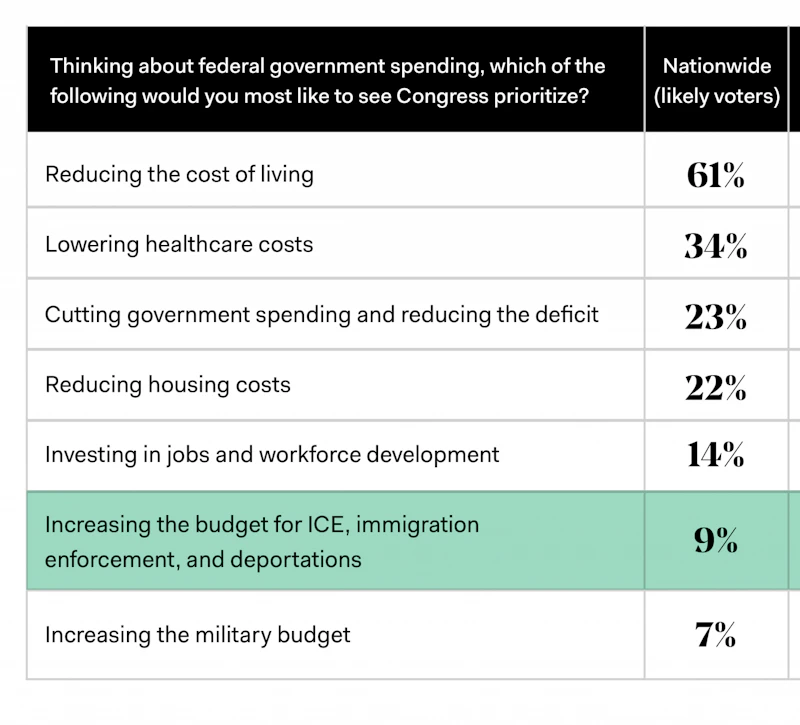
American families have grappled with affordability in recent years as the costs of essential goods and services have increased, with a majority of voters identifying the economy and cost of living as the top issues of concern for the 2026 midterm elections. More than a year into the second Trump administration, inflation remains a top concern for the majority of Americans.
But immigration policies implemented by President Trump, and more announced and proposed, such as revoking immigrant work permits, deporting hundreds of thousands of people, and limiting legal immigration, are undermining the goal of lowering the costs of everyday and essential goods and services.
In fact, all Americans, particularly working-class families, are going to see prices for goods and services like food and housing continue to increase substantially. Recent and proposed immigration policies will result in American families paying an additional $2,150 for goods and services each year by the end of 2028, or the equivalent of the average American family's grocery bill for three months or their combined electricity and gas bills for the entire year. Such an annual increase is equivalent to a tax that would erase many American families’ annual savings, and amount to one of their bi-weekly paychecks each year. Unlike past periods of inflation, Americans have not been saving at the same rate as earlier years, and cannot absorb these price increases as easily, squeezing their budgets even further. These costs are above and beyond the impacts of other economic policies like global tariffs that will also raise prices.
At the same time, millions of families with immigrant family members will also face the real, human toll of these policies, leaving many immigrant parents unable to support their families, and pushing tens of thousands U.S. citizen children into poverty. Additionally, we would see billions of dollars lost in lifelong earning contributions to the U.S. economy, and the almost immediate loss of immigrant workers, among other negative impacts.
Harmful immigration policies that would most significantly, and unnecessarily, raise the costs of goods and services include:
- The loss of work permits for millions of individuals with a temporary status, like asylum applicants, people with Temporary Protected Status (TPS) who are unable to return to their countries, paroled immigrants from Afghanistan, and Deferred Action for Childhood Arrivals (DACA) recipients, among others.
- The mass deportation of millions of immigrants with or without legal status.
- Significant reductions in new, lawful immigration in the years ahead.
Notably, these policies would negatively affect the economic prosperity for Americans, who benefit significantly from the contributions of immigrants. Our estimates of the rise in prices is fairly conservative given the promise of the current administration to push even more undocumented immigrants out of the workforce, through arrest and deportation or by pushing people to leave on their own. The actual increases could end up being much higher.
Most of these policies have already been announced and are pending implementation. For example, the administration has attempted to cancel TPS for people from Venezuela and Haiti, meaning their work permits could soon end. The administration has issued executive orders for mass deportation efforts and set arrest quotas to dramatically increase the number of arrests, detentions and deportations. The administration has also removed deportation protections and work authorizations for those paroled into the country through the Cuba-Nicaragua-Haiti-Venezuela (CHNV) policy, and has proposed new regulations to limit asylum applicants’ access to work authorization. In addition, the administration has initiated renewed efforts to limit legal immigration, including by drastically reinterpreting the “public charge” policy, stopping most refugee resettlement, banning the entry of individuals from certain countries, and pausing visa processing for people from a list of 75 countries, which will likely lead to a lower number of new legal immigrants qualified to enter the U.S. and some immigrants already here having to leave.