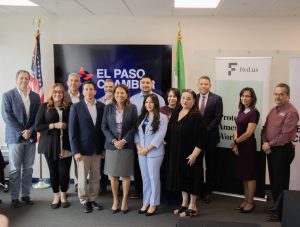
EL PASO, TX – Yesterday, FWD.us and the El Paso Chamber of Commerce hosted a roundtable event along with Congresswoman Veronica Escobar (D-TX-16) to bring together business leaders, advocates and other local leaders to discuss the critical role that immigrants play in Texas and the importance of preserving their existing protections. As part of FWD.us’ Protect America’s Workforce campaign, the event included a state of play update from FWD.us and an engaging discussion on the need to protect immigrant contributions to America’s workforce.
Participants included Congresswoman Escobar, Ricardo Mora, CEO of the El Paso Chamber, Zaira Garcia, regional government relations director at FWD.us, Victor Erives, an El Paso DACA recipient, and representatives from Centro de Salud Familiar La Fe, FloWar Business Management, Franklin Mountain Investments, Gente Del Chucho, HAWK Construction, Texas Restaurant Association El Paso Chapter, Texas Tech University Health Sciences Center El Paso, University Medical Center, and Workforce Solutions Borderplex.
The aforementioned participants discussed the importance of preserving existing protections for immigrants in the U.S., including the Deferred Action for Childhood Arrivals (DACA) program, Temporary Protected Status (TPS) and humanitarian parole to push against increasingly restrictive immigration policies being imposed by the current administration. There was also conversation around the importance of opening new legal pathways for those who are still waiting for the opportunity to gain protections.

The event also served to provide further analysis into data from FWD.us’ recently released Prices Report, which reveals that Planned policies to end immigration protections and work authorization will result in American families paying an additional $2,150 for goods and services each year by 2028.
Below are quotes from yesterday’s conversation:
Congresswoman Veronica Escobar (D-TX-16): “Immigrants are essential to El Paso’s economy, to Texas, and to our country as a whole. They are our neighbors, coworkers and small business owners who strengthen our communities every single day. As we face ongoing challenges, I am grateful to have joined FWD.us today to share my perspective and goals regarding thoughtful, fair border security and immigration policy, like my bipartisan, comprehensive immigration reform bill, the Dignity Act. I plan to continue working with partners like FWD.us to achieve lasting, successful change to ensure families can thrive and continue contributing to our shared prosperity."
Ricardo Mora, CEO of the El Paso Chamber: “El Paso’s economy is powered by hard-working people, many of whom are immigrants who keep our businesses running and help our region grow. The Protect America’s Workforce campaign highlights an urgent reality: without these workers, our supply chains, our local businesses and our families would all feel the impact. The Chamber is proud to stand with FWD.us and Congresswoman Escobar in calling for policies that strengthen our workforce and our economy.”
Zaira Garcia, regional government relations director at FWD.us, said: “Immigrants are vital to our workforce, and removing their ability to work legally would drive up prices for families and hurt our economy. Today’s discussion underscored what Texans already know: protecting immigrant workers is not only the right thing to do, it’s essential for keeping our communities and our economy strong.”
Vanessa Duran, chair of the Texas Restaurant Association El Paso Chapter: “The restaurant industry is the second largest in the state. Without our immigrant workforce, we would not be able to operate our industry, which could lead to significant repercussions for not only restaurants themselves, like my fourth generation owned family business, but all those that dine, service, and rely on our industry. It’s up to our lawmakers in Washington to find immigration solutions that work for the Texas workforce, economy, and communities.”
ADDITIONAL BACKGROUND
Key data points from the Protect America’s Workforce campaign and the Prices Report include:
- Canceling or restricting legal work permits for those with TPS and other protected statuses, including asylum seekers, would result in nearly 2.6 million workers being sidelined from the labor market.
- Some 450,000 DACA recipients participate in the labor force, contributing nearly $16 billion to the U.S. economy each year.
- FWD.us estimates that undocumented immigrants earning U.S. citizenship would annually contribute an additional $149 billion after taxes to the economy. This could result in a potential annual increase of $39 billion more in combined federal, state, and local taxes.
- Growing legal pathways for lawful immigration will meet economic and workforce needs for the future.
Additionally, in Texas alone, immigrants play a significant role in keeping our workforce and economy strong:
- An estimated 5,923,000 immigrants live in Texas, making up 19 percent of the total population.
- Immigrants live in 26 percent of households in Texas.
- Immigrants in Texas have an annual spending power of $192.1 billion and spend $55.3 billion annually in taxes.
- About 354,000 immigrants in Texas work in STEM-related jobs, of which 27 percent are temporary immigrants on H-1B and other temporary work visas. In all, 34 percent of STEM degree holders in Texas are immigrants.
- Immigrants of all backgrounds boost Texas’s communities. Some 2,108,000 immigrants, or about 36 percent of all immigrants in Texas, are U.S. citizens. About 1,420,000 are lawful permanent residents, and 361,000 are temporary immigrants (including nonimmigrant visa holders and international students).
- An estimated 12 percent of individuals in Texas, or some 3,819,000, are either undocumented immigrants or live with an undocumented immigrant. Some 713,000 U.S. citizen children in Texas live with an undocumented parent, while some 191,000 U.S. citizen spouses are married to an undocumented immigrant.
- Some 1,059,000 undocumented individuals in Texas have lived in the U.S. for more than 10 years, with 664,000 of those living in the U.S. for more than 20 years.