DHS Funding for Immigration Enforcement
Is Expanding the Reach of the Criminal Justice System

One year ago, Congress passed a bill massively expanding immigration enforcement in this country. As these ramp-ups in federal immigration enforcement unfold, it is essential to track how they rely on and will dramatically expand the infrastructure of the criminal justice system beyond ICE and DHS, worsening its incentives and norms in ways that impact citizens and noncitizens alike.

Congress has now given the Department of Homeland Security (DHS) an enforcement windfall large enough to reshape policing and punishment for years to come. These funds will increase and change financial incentives for local and state criminal justice actors for the worse, tying agencies to federal immigration objectives and increasing the capacity for heavy-handed enforcement and incarceration writ large. Simultaneously, legal rights and protections are being eroded in the name of immigration enforcement and the administration is re-centering outdated, dangerous ideas around use of force and extreme punishment. Fighting to stop, slow, and claw back federal DHS enforcement funds now and over the next few years is an essential part of combating these trends.

DHS received a $261 billion windfall for enforcement

Across the July 2025 and June 2026 reconciliation bills, Congress committed a historic $261 billion for DHS enforcement, on top of regular appropriations for FY25. This massive fund will, and has already begun to, expand the reach of the criminal justice system as well as dramatically ramp up immigration enforcement. Here’s how the largest portions of that funding breaks down across agencies:
$113.38B
ICE

44%

Detention expansion to 100K beds, deportation flights, 14,593 new officers and staff, enforcement operations, transportation, IT, facility, and fleet maintenance, 287(g) program

$90.75B
CBP

35%

Border wall ($46.6B), surveillance technology, 8,409 new agents and staff

$27.0B
DHS Slush Fund

10%

Unspecified enforcement funding with no line items, no oversight, no reporting mandates

Traditional state and local criminal justice systems are critical entities through which these funds have and will continue to flow, and who the administration intends to enlist–through incentive or coercion–in the project of heavy immigration enforcement.

This is a strategic and intentional choice by the administration. As Border Czar Tom Homan said in his January 29th press conference on drawing down federal agents in Minnesota:

“The withdrawal of law enforcement resources here is dependent upon cooperation. Like I said, one agent arresting one bad guy in jail means less agents on the street. We have some agreements. We've got more to talk about, how we're going to implement those agreements. But as we see that cooperation happen, then the redeployment will happen.”

In April, Homan called on Virginia Governor Spanberger to facilitate more cooperation between ICE and “county jailers,” saying “if you don’t let us in the jails, fine. We'll just send more teams into the streets, into the neighborhoods." Two weeks later, the governor signed legislation effectively banning such cooperation. The Department of Justice recently filed suit against Virginia. 

After New York Governor Kathy Hochul signed legislation banning local law enforcement cooperation with ICE, Homan responded by threatening an enforcement surge, saying “I made her a promise: you’re going to see more ICE agents than you’ve ever seen in New York City.” The Department of Justice sued New York in late June.

“Despite historic spending, funds are just beginning to flowroughly $125 billion remains unspent from the initial $191B windfall, and the new $70B has yet to be touched.

The dramatic infusion of cash into local criminal justice systems will expand policing, detention bed capacity, and surveillance, among other impacts. The increased mingling of these systems also weakens legal rights and protections in ways that will have harmful implications for citizens and noncitizens alike for decades to come. And despite historic spending, funds are just beginning to flow — roughly $125B remains unspent from the initial $191 billion windfall, and the new $70 billion has yet to be touched, according to recent testimony from DHS. 

Funds are allocated–and moving–to state and local law enforcement

Within the reconciliation bills, funds are earmarked specifically for local law enforcement in a number of different areas. For example:

Amount
Purpose of Funds
$2.055BTo DHS for 287(g) Task Force Models and other state and local reimbursements for participation in immigration enforcement activities.
$3.3BTo the Department of Justice for purposes including reimbursing jails and prisons for incarcerating "criminal aliens." The federal government typically pays local jails $70 to $110 per day per incarcerated immigrant.
$3.5BTo the Attorney General for the "Bridging Immigration-related Deficits Experienced Nationwide (BIDEN) Reimbursement Fund" to reimburse state and local governments for costs incurred during the Biden administration to police, prosecute, detain, or transport undocumented people.
$10BTo DHS for a "State Border Security Reinforcement Fund" that will reimburse state and local governments for purposes including drug and immigration enforcement and transporting detained immigrants.
$60.925BTo ICE for hiring and retention and other purposes, including 287(g) expansion and facilitation (though the amount for 287(g) expansion is not yet clear).

Texas’ “Operation Lone Star,” refunded by the BIDEN Reimbursement Fund, shows the impacts of the intended model: Ostensibly an effort to detect “illegal crossings” related to human or drug trafficking, the operation has instead resulted in racial profiling, arrests for misdemeanor offenses, and the prosecution of citizens for target offenses.

Cash incentives are fusing immigration enforcement to local policing

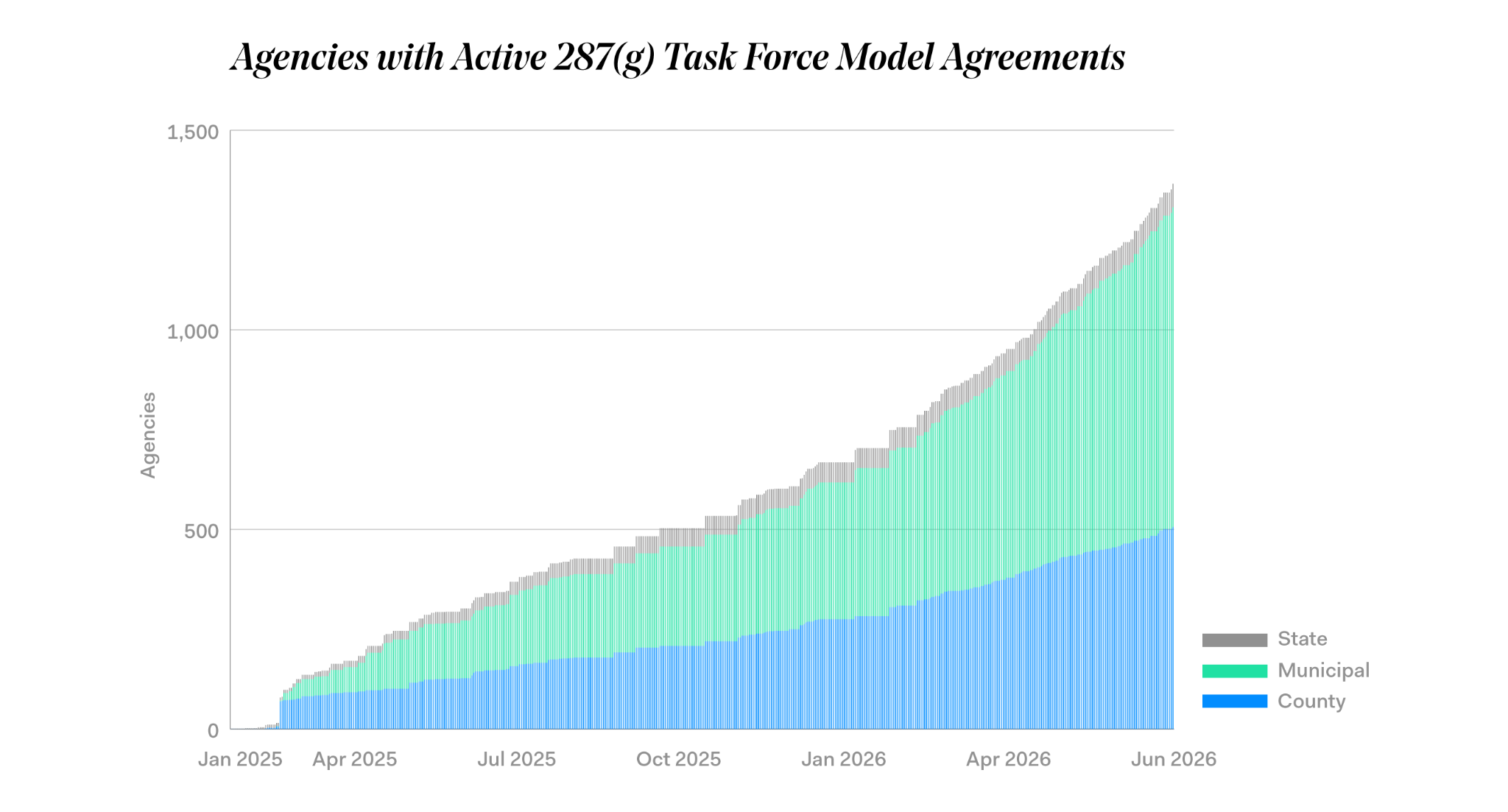
287(g) agreements are one of the clearest mechanisms reshaping local criminal justice to immigration enforcement in ways that change both systems for the worse. The number of 287(g) agreements went up by over 1,400% since the start of the Trump administration, reinforcing ties between sheriffs, jails, and federal enforcement efforts. 

The recent nomination of Lance Schroyer to lead ICE, a former Oklahoma state trooper who worked under the state’s 287(g) program, underlines the critical importance of this program to the administration’s stated goal of continuing widescale enforcement while reducing the visibility of immigration arrests. The most recent arrest data available shows that 9-10% of ICE arrests are a result of the 287(g) program, compared to roughly 3% at the start of last year. As 287(g) partnerships expand, ICE is becoming increasingly reliant on local and state law enforcement to hit their new immigration arrest quotas of 2,000 a day.   

This 287(g) program’s rapid growth is spurred by the administration’s revival of an old, and once rejected, model (the “Task Force Model”) that incentivizes state and local law enforcement agencies to sign up and become deputized to conduct immigration enforcement. Under the Task Force Model, the administration is promising to pay the salaries of trained police officers along with what amounts to bounties for “performance,” plus offering funds for new equipment and vehicles for participating agencies. At least nine states have enacted legislation, executive orders, or otherwise applied other pressure to encourage or require certain state or county agencies to join the 287(g) program.  

"1 in 4 Americans live in a state that has enrolled their state highway patrol, state police department, or department of public safety to enforce immigration law."

As of July 1st, 1,366 state and local law enforcement agencies have signed up for the revived 287(g) Task Force Model. County-level agreements alone now cover a population of over 51 million people, or 1 in 7 Americans. Twenty states have at least one state-level agency signed up, and 1 in 4 Americans live in a state that has enrolled their state highway patrol, state police department, or department of public safety to enforce immigration law. 

Florida and Texas lead the nation in immigration arrests, and more than 500 agencies across  the two states are enlisted in the 287(g) Task Force Model program. As a result, immigration enforcement frequently occurs during everyday traffic stops by local police or state troopers, leading to dramatic surges in arrests that have largely flown under the radar. Florida state officials in January, for instance, said their state and local law enforcement offices had arrested more than 10,400 immigrants through the 287(g) program.

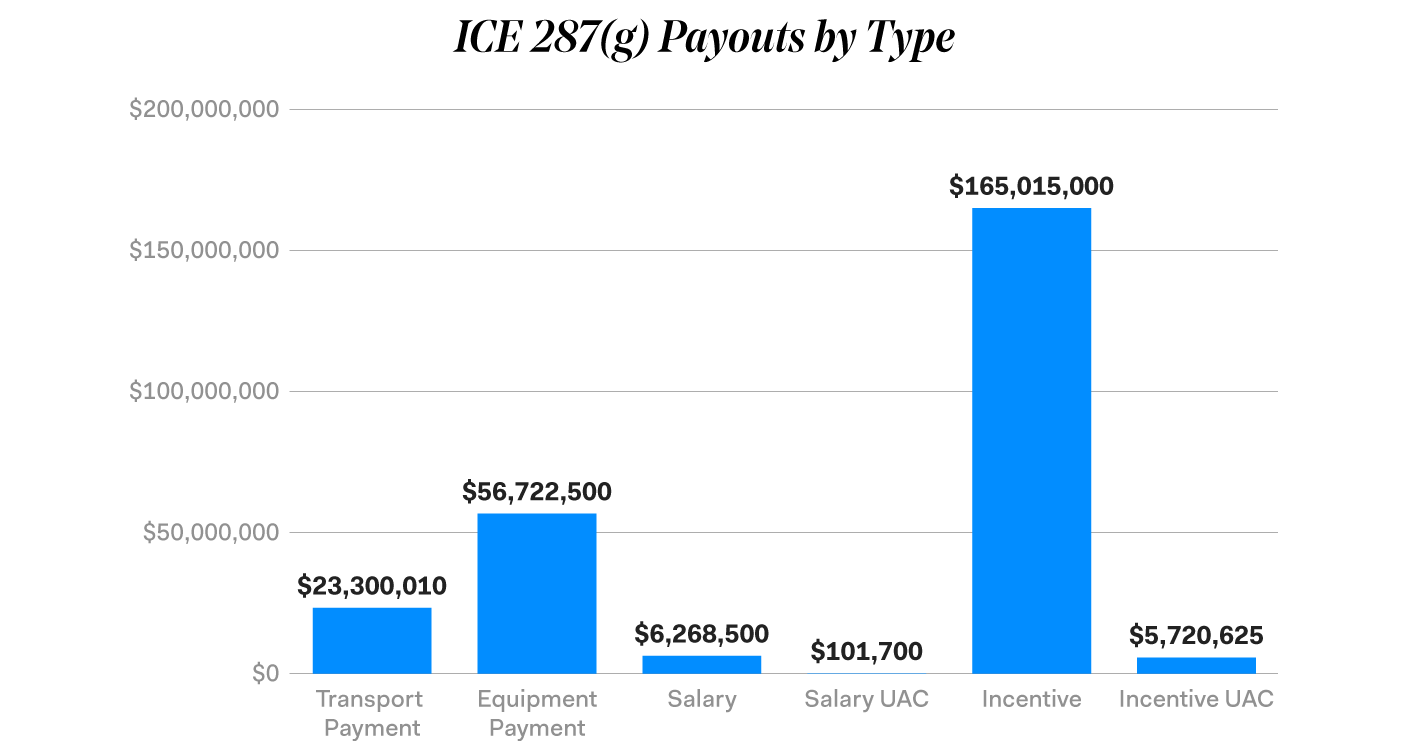
This graph contains data from a leaked 287(g) payment ledger, published on March 24, 2026. It does not reflect the present size of the Task Force Model program nor the full extent of funds currently involved. 

As of March, at least 282 agencies have received or been pledged specific funding. Agencies in Florida alone had been allocated $150M. In some cases, the funding they have already received has doubled their entire department budget. Our April analysis shows that $257M had already been allocated, the majority for “incentive payments.” The 282 departments with listed payments have deputized 7,514 local and state officers to do immigration enforcement, suggesting that there are or will be many thousands more deputized across the 1,080+ participating agencies not yet listed as receiving payments in mid-March. 

In February, we estimated that based on the number of agencies signed up and the promised funding from ICE, total funding could equal $1.4 to $2 billion in 2026. With these larger incentive payments and over 600 more agencies signing up since, the total could grow even higher. This influx of federal immigration money would massively increase federal funding to local law enforcement (the previous two largest grants together totaled about $1 billion) and drive the largest expansion of federal funding to local police since the 1990s.

To put a fine point on it: pushing billions into local law enforcement with a mandate and incentives to harass and arrest people who may appear to be immigrants is an enormous multiplier of force against Black and Brown people in this country. 

Flexible federal money will pull in agencies far beyond ICE – and fund a wide range of activities and equipment

As noted above, the reconciliation bills include $27 billion in DHS enforcement funds with no line items, little oversight, and broad discretion. Many of the other line items directed towards state and local criminal justice actors have broad flexibility. This is the financial architecture for mission creep: money appropriated in the name of immigration control can support street patrols, detention, weapons, surveillance and other technology, data sharing, task-force operations, and public-order enforcement. The massive surveillance network employed by ICE is already extending its reach, disseminating iris scanners and facial recognition  to local police despite significant error rates and privacy concerns.  

The D.C. experience shows how quickly that mission creep can happen. President Trump's March 2025 executive order on making Washington 'safe and beautiful' created an interagency task force to maximize resources across federal agencies. Public reporting in March 2026 found that at least 10 ICE arrests in the D.C. region involved U.S. Park Police, some arising from traffic stops of commercial vehicles on federal parkways. Once agencies like the Park Police and state highway patrols are folded into the immigration agenda, roadway enforcement and minor public-order policing become gateways to detention and deportation.

The infrastructure for mass detention is expanding at every level, with state and local facilities providing critical infrastructure

Federal money from ICE rentals can be a major source of revenue for local jails. This funding structure incentivizes local jurisdictions to build newer, bigger jails, and then in turn requires them to maintain or increase rented space for immigration detention, creating a harmful cycle that fuels growth of both immigration and criminal detention. The July 2025 reconciliation bill also includes funds to increase detention capacity at historic scale. 

The “Detention Reengineering Initiative” is ICE’s $38.3 billion goal to “implement a new detention model” by the end of FY26. It includes acquiring and renovating eight large-scale detention centers, 16 processing sites, and 10 “turnkey” facilities where ICE already operates/has contracts with local jails and prisons. Facing strong opposition, ICE is reportedly looking to sell or give away numerous warehouses they purchased to convert to processing sites or detention centers. But the purchase of “turnkey facilities” and other detention expansions are already underway. 

"As the administration begins to expand detention beds at the local, state, and federal level, we can anticipate not only an increase in detention related to immigration, but an expansion of incarceration and detention of all kinds."

DHS purchased two California-based private prisons from CoreCivic in early July for $1.5 billion, and is in talks with GEO Group about buying more private prisons. CoreCivic and GEO Group would continue to operate the facilities as contractors, shifting ownership to federal authorities primarily to circumvent state and local oversight and thwart litigation. ICE also announced plans to build a new facility for migrant families and unaccompanied children at a former military base in Alexandria, Louisiana, adjacent to the nation’s largest deportation hub.      

As we know from the field of criminal justice reform, “if you build it, you fill it.” As the administration begins to expand detention beds at the local, state, and federal level, we can anticipate not only an increase in detention related to immigration, but an expansion of incarceration and detention of all kinds.

Legal protections and rights are being weakened in the name of immigration enforcement

Alongside the rapid expansion in funding, the administration has systematically used immigration enforcement as the rationale to weaken essential rights and norms around stops, searches, and arrests. Administrative warrants and warrantless arrests are increasingly justified in contexts such as forced entry into homes that would have previously been unimaginable. Fundamental protections such as habeas corpus that allow people to challenge the legality of their confinement are similarly under attack.

The administration has taken an aggressive turn toward vehicle and pedestrian stops. Federal agents do not have ordinary traffic-stop authority, yet vehicle stops have become routine based on apparent racial profiling. Immigration sweeps at Home Depot parking lots, construction sites, and delivery routes now may consider race or ethnicity as one factor alongside accent, location, or work in an immigrant-heavy industry to justify a stop — a practice sometimes referred to as a “Kavanaugh stop” because Justice Kavanaugh alleged that these were “brief encounters” rather than the traumatizing events they often become. This new precedent lowers the threshold for policing overall and invites pretextual targeting based on appearance.

More broadly, the administration has recentered criminal conviction and alleged gang affiliation as a justification for extreme punishment, and attempted to normalize previously unthinkable ideas such as offshoring incarceration for U.S. citizens. The administration has also encouraged less restraint in the use of force and reintroduced outdated practices such as quota-based enforcement, a dangerous combination that those of us in criminal justice reform knew might lead to exactly the types of deadly outcomes we saw in Minneapolis.

"Once immigration enforcement is built as a sprawling public-order apparatus, protest policing, surveillance of dissent, and aggressive prosecution become part of the system's operating logic."

Recently, the administration prevailed in court in Texas, characterizing a group of protestors who gathered at the ICE Prairieland Detention Facility as members of an “antifa cell” and convicting them of providing material support for terrorism. Seven of the protesters were sentenced to at least 50 years in prison, while another was sentenced to 30 years in prison because they transported zines that fit the administration’s broad definition of antifa. 

The threats keep piling up. Federal officials confronted a poll worker in New York in June about her Instagram post naming the ICE agent that killed Renee Good, claiming she committed a federal crime. In July, the administration threatened state elections officials with criminal prosecution in the event any non-citizens receive a ballot, escalating the clash with states refusing to hand their private voter data over to the DOJ. 

The lesson is broader than any single case: once immigration enforcement is built as a sprawling public-order apparatus, protest policing, surveillance of dissent, and aggressive prosecution become part of the system's operating logic. 

Combating these trends is possible, and happening now

One major lesson for those who object to the administration’s enforcement overreach – on immigration and more broadly – is to keep the focus on the money now and in the long-term, at the federal and state and local levels.

To combat these trends…

  • Congress can keep fighting to claw back DHS funding for enforcement and use them to address the American people’s concerns, starting with healthcare
  • Local and state officials can refuse to accept federal enforcement funds and ban funding and cooperation agreements
  • Communities and local officials can block expanded detention capacity, from warehouses to local jails and state prisons
  • States can penalize private prison companies
  • Congress, along with state and local policymakers, can investigate the use of federal funds for local policing
  • Local communities can demand leadership prioritize local public safety funds for community-safety investments
  • Elected officials can exercise oversight authority and visit detention centers of all kinds – immigration, jails, and prisons
  • For more suggestions on how to take action, check out our ‘Everyday Guide to Freedom

The Democrats scored a major victory by successfully splitting funding for ICE and CBP out of the rest of the funding package, after holding firm through the longest partial shutdown in history. The June 2026 DHS funding package passed without a single vote from a Democratic lawmaker. Democrats held the line and effectively contrasted these funds with what Americans actually want: investments in healthcare and to address the cost of living

Yet as long as the Republicans continue to control both chambers of congress, they are able to continue funding these extreme and unpopular policies. Having rallied public opinion (including driving ICE disapproval to new highs), continuing to communicate about the consequences of these funds and campaign against them as they roll out remains a priority.In late January, Sen. Bernie Sanders proposed an amendment to claw back the $75 billion that was allocated towards ICE in the 2025 reconciliation bill and redirect those funds to restore cuts to Medicaid, a policy with proven public safety returns. Far from fringe, every Democrat and two Republicans voted in support.

Local and state actors can also continue to reject and block federal funds that expand criminalization in the name of immigration enforcement. From blocking warehouse purchases to investigating the use of federal funds for local policing, local actions can slow the flow of these funds. The more ingrained they become in more revenue streams, the harder they will be to claw back so every action to reject and block funding now has an outsized impact. States and localities can and are banning 287(g) agreements, or limiting their scope. State and local officials can also demand that their sheriffs stop renting jail space to ICE, or pursue legislation to block private prisons

When voters are exposed to the dramatic changes to our immigration and criminal enforcement systems, they demand accountability and action. Following the killings and violence in Minneapolis, a series of national polls showed sharp resistance to the administration’s approach and clear support for Democrats’ decision not to provide additional funding to ICE and CBP. As noted above, local communities all over the country have and are pushing back–and using creative tactics– to stop the sale and use of warehouses for ICE detention. Recent coverage suggests the pressure campaign is working: ICE is now looking to offload at least seven of the 11 facilities purchased. Voters can also demand that local public safety funds be used in ways that run counter to the administration’s enforcement goals, prioritizing local funds for proven community safety investments rather than for the expansion of surveillance tools or detention capacity.

We don’t have to accept the dramatic expansion of immigration and criminal enforcement being pushed by the Trump administration. Across the country, at all levels of government, we can slow, stop, and claw back funds set to pour into these systems – to the benefit of immigrants and citizens alike.


Get in touch with us: