fwd.us
Donate
  • Executive Summary
  • Introduction
  • Parole Board Structure
  • Eligibility and Outcomes
  • Barriers to Parole
  • Recommendations
  • Conclusion
Parole Reform/Policy & Research/Criminal Justice/Mississippi/Storytelling/State Policy

"They Just Denied Me":
Parole Stories and Case Studies

February 3rd, 2026
ByTinsae Gebriel and Marie Ndiaye

Executive Summary

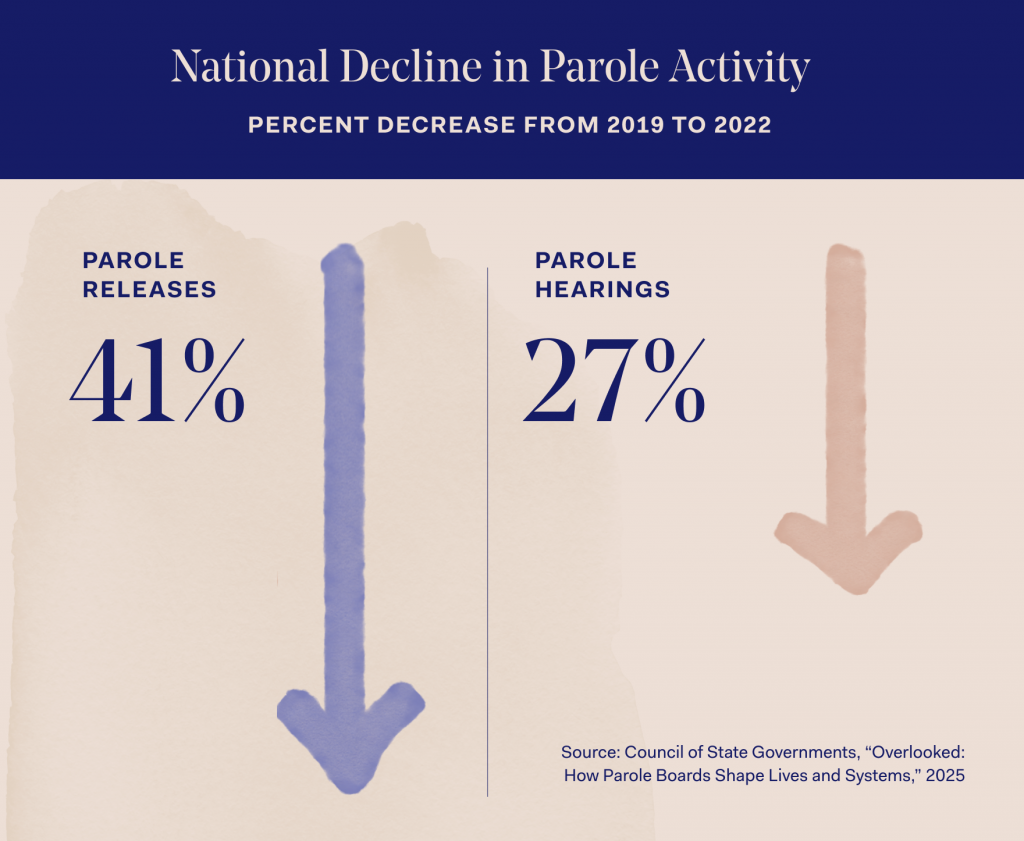
Parole is a vital component of a well-functioning criminal justice system that incentivizes good behavior, promotes rehabilitation, and safely reduces prison populations, but its effectiveness heavily depends on how it’s administered. The promise of parole has long been undermined by counter-productive, opaque, and inconsistent practices nationwide — and reality is only getting further from the ideal. Between 2019 and 2022, the number of people released on parole fell by 41% and it’s estimated that over 210,000 people remain in prison past their parole eligibility date. 

This policy brief examines parole policies and practices in Missouri, Mississippi, and New York to highlight the systemic barriers to a fair parole process that are contributing to the nationwide decline in parole use. Each state presents a distinct context but reflects common challenges with parole systems nationwide: excessive weight placed on the original crime of conviction, the inability to meaningfully present a case for release to the board, and parole deliberations that lack transparency and public oversight. Together, these practices make parole release exceedingly difficult to achieve and help to explain why so many parole hearings result in denials.  

The evidence shows that meaningful release opportunities, such as parole, make prisons safer and reduce recidivism, and are extremely popular with the public. States across the country should improve their parole systems by:

  • Adopting clear, measurable standards with guardrails
  • Prioritizing rehabilitation over past offenses
  • Increasing transparency and accountability to the incarcerated person and the public

In doing so, they can provide meaningful opportunities for release without compromising public safety.

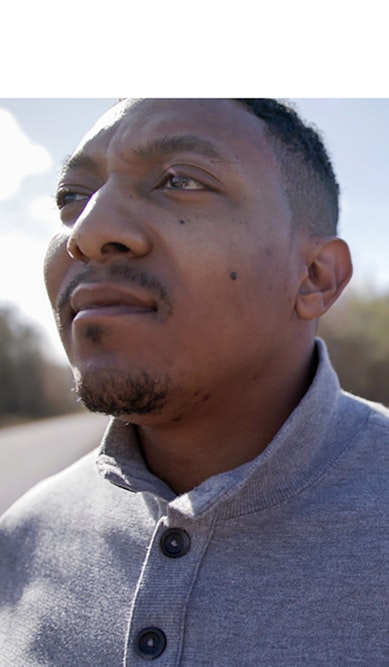
Video Image

Parole Stories: Carol and Bill

Carol and her incarcerated son, Bill, share their story of navigating Mississippi's parole process and the impact it's had on their family.

Introduction

“It's hard once you see you get denied. The loved ones on the street [are] doing time with you. Any family member that's took [sic] away from the family, of course it's going to be hard on everybody. You’re going to try to downplay it. You got to be strong for the people on the street…it's not just you in here doing time.”

– David, Mississippi, incarcerated man

Second chances for people in prison, including parole, are crucial to ensuring public safety. Parole is a vital component of a well-functioning criminal justice system; it incentivizes good behavior, promotes rehabilitation, and safely reduces prison populations and the costs associated with incarceration. Importantly, parole reunites families, making households and communities whole. 

Parole can be a powerful tool to safely reduce prison populations, but its effectiveness heavily depends on how it’s administered. In the 35 jurisdictions1 that have discretionary parole for most eligible people, the process is often opaque and does not produce the results we expect from a well-functioning system. Life-changing decisions are made behind closed doors by political appointees who rely heavily on static criteria about an individual’s past offense rather than the personal growth and change they’ve exhibited since their incarceration. In many instances, applicants may not even get the opportunity to present a meaningful case before the board. 

The way parole is currently implemented undermines both legislative intent and public expectations. Parole is meant to provide a meaningful path toward second chances, yet it’s becoming increasingly restrictive. Nationally, the number of people released on parole fell by 41% between 2019 and 2022. Parole boards are also holding fewer hearings – down 27% during the same period. Even when hearings do occur, release remains a long shot in many jurisdictions. Compared to 2019, only seven states saw an increase in their parole grant rate in 2023 or 2024 (the most recent data available), while 21 experienced a decrease. This decline in parole releases carries profound consequences: it’s estimated that over 210,000 people remain in prison past their parole eligibility date.


“You get very excited, hoping and praying that maybe this will be the one. He'll finally get to come home. We'll finally be a family again. And then when you get the news that once again, they've been turned down, there's a sadness that comes.”

– Carol, Mississippi, mother of an incarcerated son

The under-utilization of parole results in longer periods of unnecessary incarceration, increased financial and emotional strain on families, and weakened incentives for rehabilitation. Studies over the last two decades have made clear that lengthy sentences offer a diminishing return on safety, and incarceration can actually increase the likelihood of returning to jail or prison. Furthermore, incarceration imposes deep harm on individuals and their families: families and children of incarcerated people suffer physical and emotional health repercussions, shortened life expectancy, and reductions in lifetime earnings. On average, people with an immediate family member in prison spend nearly $4,200 every year to maintain contact and cover their loved one’s basic needs behind bars. Each additional year a person remains in prison as a result of being denied parole places additional financial strain on a family. Families directly impacted by incarceration also continue to experience reduced earnings long past their loved one's return home, with formerly incarcerated people losing $111 billion in earnings each year and children of incarcerated parents experiencing more than $215 billion in lost earnings. Beyond the financial toll, loved ones ride the wave of hope with every new hearing that brings renewed possibility of release, only to face the heartbreak of yet another denial.

This policy brief examines parole policies and practices in Missouri, Mississippi, and New York – three states that help illustrate some of the factors contributing to the nationwide decline in parole use and provide recommendations for a path forward. Missouri has a unique opportunity to advance meaningful parole reform this session with the governor’s commitment to evaluate and amend existing parole rules. In Mississippi, recent legislation has expanded parole eligibility, but release outcomes continue to hinge on the board’s political will to implement the policy to reach its full impact. Meanwhile, advocates in New York are continuing their years-long effort to expand early release opportunities to elderly people and address the barriers that limit meaningful access to parole. Each state presents a distinct context but reflects common challenges with parole systems nationwide, highlighting why strengthening parole processes is essential to any serious effort to reduce incarceration and increase public safety.  

Parole Board Composition and Structure

The composition of parole boards and how they come to be are all factors that determine the fairness and effectiveness of the parole process. Board members’ professional backgrounds influence what factors they prioritize; their appointment structures can influence whose interests they serve; and their numbers can dictate how much attention they provide to each individual. 

Board Size and Appointment

The states examined here share commonalities in parole board structures. All of their board members must be appointed by their respective governors with the advice and consent of their senate bodies. Mississippi's Parole Board has five members who serve “at the will and pleasure of the Governor” for terms that last at least four years. Missouri's Parole Board has seven members who serve without term limits, and New York's Board of Parole can have up to 19 members serving six-year terms.

Although parole boards serve a technical function, they are driven by politics. Since board members are appointed and confirmed through an overtly political process, their incentives may align more with political considerations than individual assessments of rehabilitation. This dynamic can encourage denying parole because it’s the safest political option. In some states, it’s not uncommon for board members to receive letters from the governor, attorney general, or other elected officials discouraging release of an individual up for parole consideration, further entangling parole decisions with political pressure rather than an objective evaluation of an applicant.

Professional Background and Qualifications

Professional requirements for parole board members vary. In New York, parole commissioners must have either a college or graduate degree and at least five years of experience in a list of eligible fields, such as criminal justice, law enforcement, social work, or at least ten years of relevant professional experience in these fields without a degree. By contrast, Missouri has no educational requirements for Board members. Mississippi requires only that board members have a bachelor's degree or a high school diploma accompanied by four years of work experience. Mississippi law requires Board members to complete annual trainings that are developed based on guidance from correctional associations. Neither New York nor Missouri statutes require board members to complete training upon their initial appointment or to participate in ongoing annual training thereafter. Despite what seem to be broad eligibility criteria, parole boards tend to favor people with law enforcement or corrections backgrounds. These individuals may have little to no knowledge of how to evaluate successful behavioral change. In recent years, advocates in states such as West Virginia and Oklahoma have successfully advanced reforms to diversify parole boards by requiring a certain number of members have a background in social work or behavioral services.

Current Parole Eligibility and Outcomes

Eligibility rules determine who can seek parole and when. These thresholds vary dramatically across states and have shifted significantly over time, often in response to political pressures rather than evidence about what works to keep communities safe.

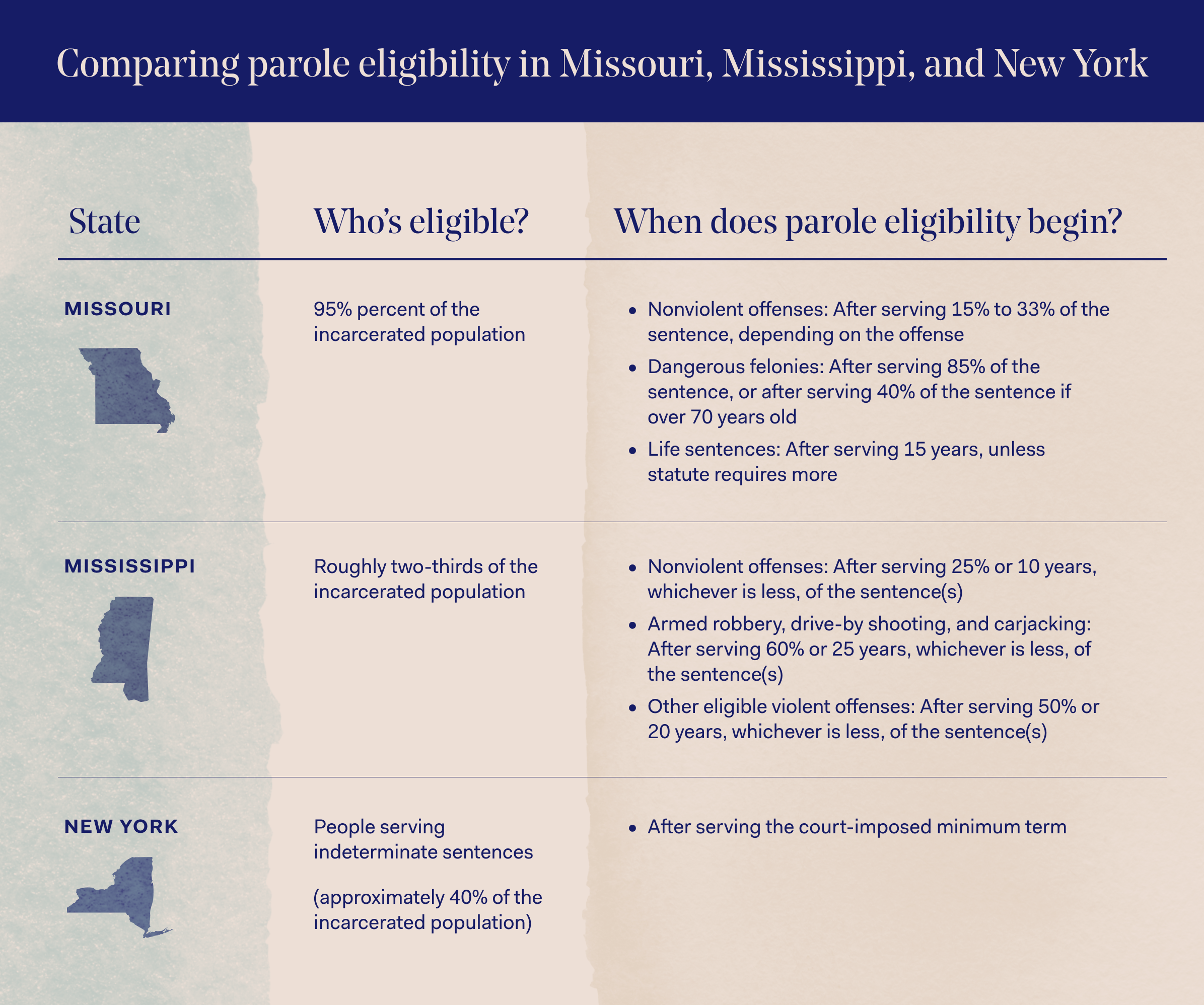
Mississippi has undergone dramatic shifts in parole eligibility over the past three decades. Before 1994, nearly everyone sentenced to prison in Mississippi was eligible for parole. However, in 1995, Mississippi joined many other states in abolishing parole. Over time, state lawmakers began reversing course in 2008 by restoring parole for nonviolent offenses, and then expanded eligibility to some people convicted of designated violent offenses in 2021. Currently, around two-thirds of people in Mississippi’s prison population are eligible for parole. The expansion of parole eligibility in 2021 represents a positive step for Mississippi, and data has shown it to be an outstanding success. Of those who became newly eligible, 97% did not return to prison on a new sentence within their first three years of release. 

Unfortunately, even as the eligibility pool expanded, Mississippi began releasing fewer people on parole — even for those who had previously been eligible. Parole grant rates dropped from an average of 70% from January to June of 2021 to 57% in the same period of time in 2025, and the total number of hearings resulting in a parole grant declined 17%.2

New York allows parole consideration once individuals with indeterminate sentences (approximately 40% of the prison population) have served their court-imposed minimum term. This leaves many with no opportunity to come home, including those without parole-eligible sentences and those who will not reach parole eligibility until extreme old age. As of 2019, there were more than 1,100 people over the age of 55 who had served 15 years in prison and were still not eligible for release. From 2008 to 2021, the share of older New Yorkers age 50 and over in state prisons more than doubled, rising from 12% to 24% of the prison population. Older individuals are much less likely to commit a crime after release and often face significant health issues, making their continued incarceration both unnecessary and costly. 

New York has a low approval rate for parole, hovering below 40%. A 2019 survey of 409 individuals who had been denied parole conducted by the Correctional Association of New York found that 17% were still in prison five to 10 years past their parole eligibility date, and another 16% were 10 to 20 years past their eligibility. 

Almost everyone in prison is eligible for parole in Missouri. Missouri's eligibility framework involves a matrix that assigns a minimum percentage of time to be served based on offense category and criminal history. Generally, thresholds range from 15% to 33% for nonviolent offenses and up to 85% for designated dangerous felonies, with some exceptions. What makes Missouri's situation particularly striking is how many people remain incarcerated despite having reached eligibility: the Council of State Governments estimates that approximately half of the state's prison population had already passed their parole eligibility dates as of 2023.

Missouri has previously implemented successful, evidence-based reforms, such as the use of grid release decisions, which reduced the number of hearings held by the Parole Board by automatically approving people convicted of certain offenses for parole upon their eligibility date. Grid release contributed to a rise in the share of releases to parole from 62% in FY 2018 to over 70% in FY 2020-2021. From July 2019 to December 2021, an average of 28% of parole release decisions were due to grid releases. Importantly, this increase in the use of parole did not compromise public safety. Three-year overall recidivism rates for the FY 2020 and FY 2021 release cohorts either decreased slightly or remained virtually unchanged compared to FY 2018, and remained significantly lower than the recidivism rates among those released in FY 2015 and FY 2016. 

However, this positive momentum has recently reversed. The prison population has increased for four straight years (FY 2021 to FY 2025), driven in part by individuals aged 50 and over. During this same period, parole as a percentage of prison releases declined from 72% to 62%. Missouri has the opportunity to reverse this trend by adopting mandatory standards, instead of the largely discretionary system currently in place, that prioritize rehabilitation and release.

Systemic Barriers to Fair Parole

Over-Emphasis on Static Factors

“My record during incarceration has been pretty good…I've participated in every program that has been available to me. Like right now, I'm attending seminary… But I say it's irrelevant because, well, I'm still here.”

– Bill, Mississippi, incarcerated man

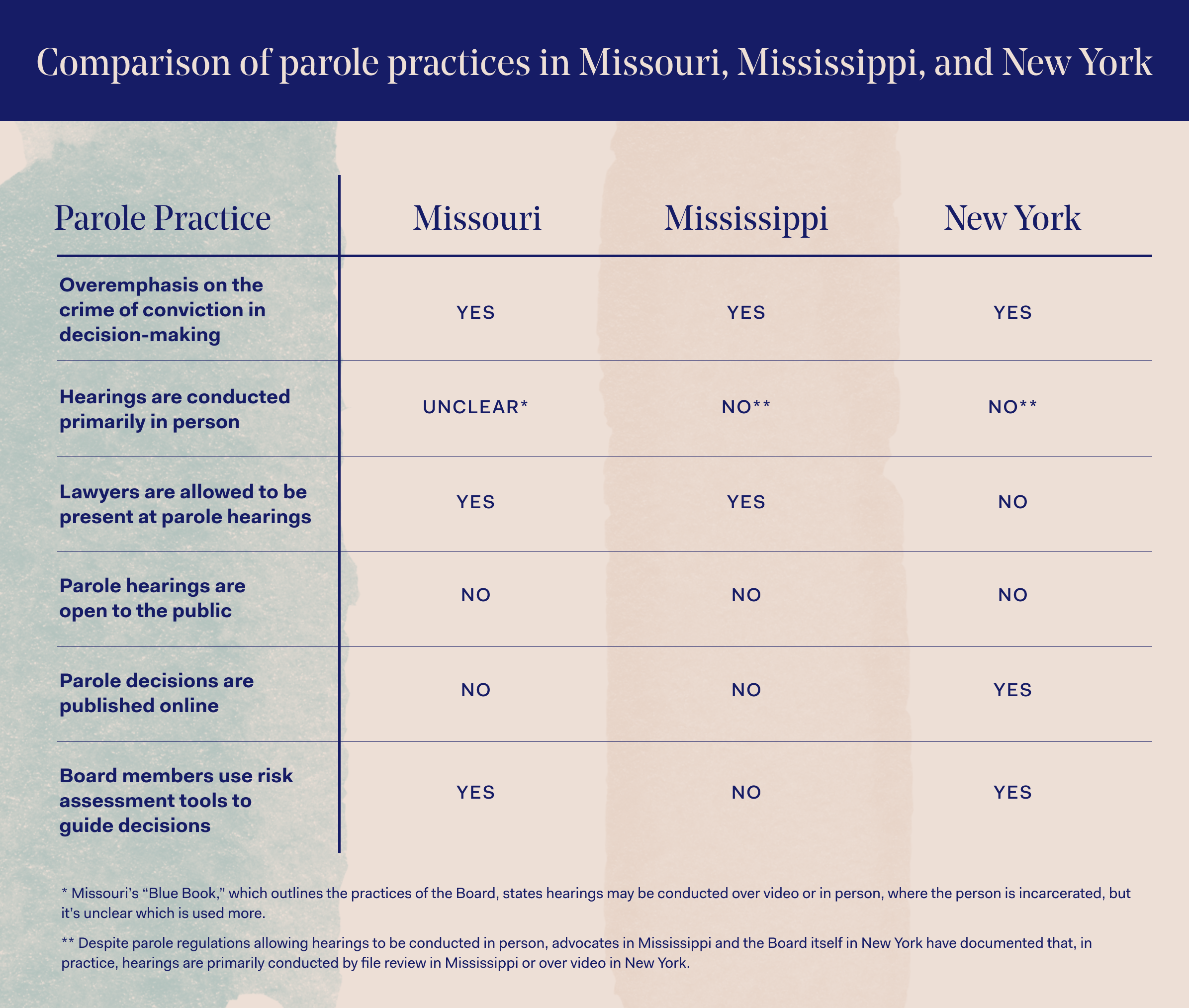
Across all three states we examined, parole boards place excessive weight on static, backward-looking factors—primarily the original crime of conviction—at the expense of evidence of rehabilitation and change. This is the one factor incarcerated individuals cannot alter, and it keeps people tethered to their past and discourages personal transformation.

In Mississippi, many of the factors that can weigh against parole are static factors dealing with the past, such as the serious nature of the offense, the number of offenses committed, police and/or prior juvenile record, and prior felony and misdemeanor convictions. In New York, discretionary parole can be granted only after the board determines that release “will not so deprecate the seriousness” of the crime. Missouri’s Board has “reserve[d] the right to consider total offense behavior as an aggravating factor in decisions” when swaying from the guidelines. 

“Everyone gets a response on paper through the mail. The response is always the circumstances of the offense. It is the only thing I cannot change. The only thing I can change is to rehabilitate myself.”

– Laura, Missouri, formerly incarcerated woman

For incarcerated people who have demonstrated genuine personal growth and have spent years completing rehabilitative and educational programs and learning trades, these considerations mean that no amount of personal transformation can meaningfully overcome their past crime. As a result, parole doesn’t function as a real pathway home. Using the crime of conviction as a reason to deny parole is at odds with the criminal trial process, which has already adjudicated guilt and imposed a sentence. A denial based on the seriousness or characteristics of the crime allows the parole board to effectively override the legislature and decide that the statutory minimum is not enough. This second-guessing of sentences already imposed transforms parole boards into shadow sentencing bodies operating without the procedural protections of a courtroom. 

“The nature of the crime is going to always be the nature of the crime because it can't change. But over time, the person who committed the crime changes… I've accepted responsibility. I have community and family support. I have a pristine record in prison. I've helped so many other people in and out of prison… It drains me every time I have to look at that paper, and they say, ‘We [are] denying you for the nature of your crime. We’re denying you for a crime that took place almost 38 years ago’.”

– Dave, New York, incarcerated man

Lack of In-Person Hearings 

When it comes to parole, the term “hearing” is often a misnomer. In Mississippi, hearings may be conducted by file review, in person, by phone, or by video conference, at the discretion of the Board. In practice, though, most “hearings” consist primarily of file reviews rather than in-person proceedings. In New York, most interviews are conducted over video, according to the Board’s website, while hearings in Missouri can be held via video conferencing or in person. 

“I didn't have a parole hearing. They just denied me. I didn't go in front of nobody [sic]. They just brought me a piece of paper."

– David, Mississippi, incarcerated man

A file review can hardly be considered a hearing at all. Deciding to grant or deny parole entirely on a file, without affording individuals the opportunity to appear and be heard or be able to articulate their growth and intentions for the future, calls into question the fairness of the process. Conducting interviews by video or phone can also distance applicants from the Board, undermining their ability to communicate in a manner that would help the Board understand and see their growth, remorse, and readiness for reentry. Research has found that even minor audio and visual glitches during the hearing could have life-altering consequences: one study found that parole hearings that had video glitches were 12 percentage points less likely to result in a parole grant. This finding underscores how the absence of face-to-face interactions during parole proceedings can unjustly influence outcomes in decisions for the worse. 

“My hearings [have been] on TV…I think it hurts because we can’t see each other face to face. I can’t really see their face. [They can’t] see my reaction to their reaction. Video is not really personal and most of the time they shut off the video and you don’t know what’s being said behind there when they take a minute or two to discuss something… I prefer to see everything for what it is right in front of me.”

– Eddie, New York, incarcerated man

Inadequate Access to Legal Counsel

The states examined vary in whether incarcerated people can have legal counsel or other advocates present during parole hearings. Missouri allows incarcerated individuals to have a representative of their choice at the hearing who can offer a statement, ask questions, and provide information requested by the hearing panel. Mississippi allows individuals to have the opportunity to be represented by a lawyer at their own expense, as long as they notify the Board in writing before the hearing. However, since most decisions are made through file reviews in Mississippi, allowing access to a lawyer offers little practical benefit without a live hearing taking place. In contrast, lawyers are not allowed to be present in New York, which deprives incarcerated individuals of critical legal support at the moment when their freedom is being evaluated, leaving them to navigate the stress of answering complex questions or addressing past conduct alone. 

“Not long enough. Not the questions that would’ve been pertinent to them truly considering me going home…was I in there 9 minutes? Was I in there 11 minutes? I had been stressing out [about] this for months. My family had been stressing, praying, hoping for months.”

- Laura, Missouri, formerly incarcerated woman

Lack of Transparency and Oversight

“There isn't any clear instruction of ‘these are the guidelines we want you to follow, and these guidelines will help us determine whether or not you should be granted parole.’ So even now, after all these hearings, I still can't tell you what the parole board wants.”

– Bill, Mississippi, incarcerated man

Parole systems in Mississippi and Missouri operate behind a veil of secrecy that limits external accountability and prevents incarcerated individuals from fully understanding the process or the information used against them. In both states, parole hearings are closed to the public, and information and documents prepared by the Board are considered confidential. New York offers somewhat more transparency. The state publishes individual parole decisions online, listing the hearing outcome alongside a person’s demographic characteristics such as race and date of birth, but still does not provide information about the rationale behind individual decision-making to the public. 

This lack of transparency means incarcerated individuals may receive cursory reasoning for a denial, such as insufficient time served or the nature of the offense, but don’t get the detailed rationale or supporting explanation that could help improve their chances of release at a future date. Without access to this critical information, incarcerated individuals are unable to target rehabilitative programming or demonstrate readiness for release in ways that align with board expectations. This opacity undermines the motivation to engage in rehabilitative programming, maintain good conduct, or plan meaningfully for reentry, since individuals are left to navigate a blurred process without a comprehensive understanding of how they’re being evaluated.

“As time went along, I started asking them, ‘what can I do to better my chances?’ And tried to get more information... I took the hits the first three or four times but after that, I couldn’t comprehend why they kept on hitting me or why they were not telling me what I could do to better my chances.”

– Eddie, New York, incarcerated man

Reliance on Risk Assessment Tools

Both New York and Missouri’s Board rules and regulations incorporate a risk assessment tool in decision-making. While risk assessment tools are intended to create uniformity and consistency in outcomes, research shows that these tools, when used at any stage of the criminal justice system, reproduce the very biases they are built on. Factors such as prior arrests or patterns of police contact often reflect unequal enforcement rather than actual differences in risk. Higher scores don’t indicate higher risk, rather, they reflect the disparate impact of the criminal justice system. When a parole board is instructed to treat these scores as central guidance to their decision-making, it risks elevating biased data over evidence of rehabilitation. Although both states allow the board to depart from the risk assessment score, there’s no safeguard to protect against inconsistent or overly subjective departures driven by individual commissioners’ biases. 

“I got a letter telling me I was denied…why can't I speak on my own behalf? At least let me speak of myself. Let me advocate for myself.”

— Tiffany, Mississippi, formerly incarcerated woman

Recommendations

One of the challenges in reforming parole is that there are as many parole systems as there are states. While practices differ widely across the country, there are practices that would help ensure a fairer process for incarcerated individuals and their families everywhere. Ensuring people have a meaningful opportunity at release promotes rehabilitation and ultimately protects public safety. Research consistently shows that offering genuine, attainable pathways to parole release benefits not only incarcerated individuals but also correctional facilities and broader public safety. When a state restricts mechanisms of release or removes incentives for early release, it experiences drastic consequences in terms of institutional behavior. Early release opportunities, such as parole, are also widely popular among voters. Recent polling conducted by FWD.us found that 72% of likely voters support expanding parole to allow more people to be considered for release by a parole board. 

Studies show that policies restricting or reducing parole and earned time credit increase misconduct—violent misconduct, in particular—in prisons. For instance, after Florida enacted a "truth-in-sentencing" law that significantly reduced early release, people sentenced under the new regime had 91.1% greater odds of committing a prison infraction and 56.3% greater odds of committing a violent infraction. North Carolina saw similar results, with a 19.4% increase in disciplinary conviction rates following comparable legislation. 

The evidence points in one direction: meaningful release opportunities work. The following recommendations address the systemic shortcomings identified in our case studies and offer a path toward fairer, more effective parole systems.

Recommendations for a Fairer Parole Process

The tension between discretion and guidelines presents a genuine challenge for parole reform. Too much reliance on rigid guidelines or flawed risk assessments can produce unjust results; too little structure can enable arbitrary decision-making. The answer is not to eliminate discretion but to ensure it operates within meaningful guardrails that prioritize evidence of rehabilitation and provide clear standards that individuals can work to meet.

1. Increase Procedural Fairness and Transparency

a. Create Clear Standards with Real Accountability

A fair parole system should convey, with some certainty, what is required to receive parole and grant parole once those requirements are met.

States should establish clear, measurable, and attainable criteria for parole release. When boards depart from these criteria, they should be required to provide detailed, individualized explanations – subject to meaningful review by an independent body. 

b. Adopt Presumptive Parole and Grid Release Mechanisms

States can also ensure that standards are applied consistently by adopting release mechanisms like grid release and presumptive parole.3 Presumptive parole or grid release allows individuals to be released if specific evidence-based criteria are met, such as eligibility based on offense, engagement in rehabilitative programs, and demonstrated readiness for reintegration into the community.

As shown in Missouri, opportunities for automatic release upon meeting certain standards do not endanger the public. Mississippi has a similar presumptive parole system in law that has never been implemented. Other states, including Oklahoma and South Dakota, have also effectively used these systems to ensure individuals who are ready and safe to be released are not held unnecessarily past their parole eligibility dates, and parole board time is spent on more difficult cases. 

c. Increase Transparency and Accountability

It is also important to have a transparent system in place. Parole systems with broad confidentiality provisions, such as in Missouri and Mississippi, limit external accountability.  Neither state's hearings are open to the public, and neither do they publish their parole decisions or reasons for parole denials. There is no check on bias or arbitrary decision-making. Currently, only 15 states with discretionary parole publish individual parole decisions online, including New York. Four states – Massachusetts, Montana, Rhode Island, and Utah– also publish the reason for parole denial.

Parole hearings should be open to people of the incarcerated person’s choosing, including lawyers and members of the public who can demonstrate community ties and speak to release plans. States should require disclosure of all information the Board relies upon in making decisions, providing incarcerated individuals the opportunity to review and respond to adverse information during the process. This transparency serves multiple purposes: it allows individuals to understand what steps might improve their chances in future hearings, it enables external oversight of Board decision-making, and it builds public confidence that release decisions are made fairly and consistently.

2. Reform Decision-Making Criteria

a. Center Decision on Rehabilitation and Current Risk

Parole boards should be required to give primary weight to evidence of rehabilitation. One of the biggest impediments to parole release currently is parole boards’ overemphasis on static, non-changing factors, particularly the crime of conviction. That is also the one factor that incarcerated individuals cannot alter.

Parole boards should instead be required to evaluate evidence of rehabilitation – factors like program completion, educational achievement, institutional conduct, and reentry planning. These are the considerations that were not in existence at the time of the original criminal adjudication. They reflect the work that the person has put into personal transformation. Prioritizing anything else essentially elevates the opinion of the parole board over that of the sentencing judge, the legislature that established parole eligibility, and ultimately the public who elected those legislators.

3. Ensure a Meaningful Hearing Process

a. Require In-Person Hearings

States should guarantee in-person hearings for all parole-eligible individuals, outside of grid or presumptive release, with adequate time for incarcerated individuals to speak on their rehabilitation and readiness for reentry. While virtual hearings offer logistical advantages, they should be the exception, not the rule, given their documented shortcomings and lack of personal connection. 

b. Allow Legal Counsel at Hearings

All states should allow incarcerated individuals to have access to a lawyer or representative of their choice during their parole hearing. This access would allow incarcerated people to respond effectively to the parole board’s concerns and make a compelling case for their release. 

c. Mandate Representation of Board Members with a Background in Social Work or Behavioral Health

A national analysis of parole boards in 2023 found that nearly half of board members have a background in law enforcement, as a lawyer, or as a judge, compared to just 11% who have a background in social work. The states examined currently have no requirements reserving a certain number of parole seats for individuals with non-law enforcement backgrounds. Although New York lists qualifying professional experiences for appointment to the Board, including expertise in social work, psychology, or sociology, it does not mandate representation from these fields. States should diversify their parole boards by requiring a minimum number of members to have experience in behavioral health and social work to ensure balanced perspectives and a fuller consideration of rehabilitation and reentry.  

Conclusion

The stories highlighted in this brief illustrate the critical need for reforms to our parole systems. The promise of parole as a vital component of public safety and criminal justice reform is being undermined in states across the political spectrum. Across these three distinct jurisdictions, the process has devolved into an obscure, highly discretionary, and punitive system that disregards demonstrated growth and readiness for release and undermines a fair and meaningful hearing experience.

The path toward a fairer, more effective parole system is clear. By adopting explicit, measurable standards with guardrails and prioritizing rehabilitation over the unchangeable facts of the past, states can provide meaningful opportunities for release without compromising public safety. Furthermore, increasing transparency and accountability by opening hearings and disclosing decision rationale is essential to ensure consistency and prevent bias, as well as build public trust.

Across the country, tens of thousands of people’s fates are in the hands of parole boards, and thousands more will become parole eligible with each passing year. The recommendations laid out in this brief are just some interventions that honor the legislative intent of parole and create a criminal justice system that delivers on the promise of second chances, making communities safer and families whole.

The quotes in this brief are from interviews with currently and formerly incarcerated individuals who have experienced the parole process in Missouri, Mississippi, and New York, and family members. Each person provided consent to publish the quotes shared in this report and was also given the option to have their printed quotes attributed to a pseudonym. The interviews were conducted in partnership with Release Aging People in Prison, MacArthur Justice Center, and Show Me Justice For All.

Leah Wang, “Parole in Perspective: A Deep Dive Into Discretionary Parole Systems,” Prison Policy Initiative, October 2025, ​​https://www.prisonpolicy.org/reports/parole.html.

Missouri Parole Board, “Procedures Governing The Granting Of Paroles And Conditional Releases,” September 2019, https://doc.mo.gov/sites/doc/files/media/pdf/2019/08/20190725_Blue_Book_V2_0.pdf. 

MO Rev Stat § 217.665.

MS Code § 47-7-5.

Mississippi Administrative Code, Title 29, Part 201.

NY Exec L § 259-b.

NY Exec L § 259-c.

NY Exec L § 259-i.

New York Codes, Rules and Regulations, Title 9, § 8002.2(a).

New York Codes, Rules and Regulations, Title 9, § 8006.4.

The Council of State Governments, “Overlooked: How Parole Boards Shape Lives and Systems,” March 2025, https://projects.csgjusticecenter.org/overlooked/keffectiveey-findings/.

  1. The 35 states with discretionary parole for most eligible people include Louisiana, which eliminated parole eligibility prospectively in 2024, and California, which largely abolished parole in the 1970s but retained eligibility for some offenses, and has passed reforms extending parole eligibility to certain groups in the last 13 years.
  2. Based on FWD.us analysis of monthly parole hearing statistics produced by the Mississippi Department of Corrections.
  3. The Missouri governor’s newly formed parole working group has recommended expanding grid releases to permit presumptive release without a hearing for certain classes of offenses as well as allowing up two representatives to join hearings who can speak on rehabilitation or barriers to release. See Samantha Jackson, “Governor Kehoe reveals updates for Missouri parole process,” October 2025, https://www.komu.com/news/midmissourinews/governor-kehoe-reveals-updates-for-missouri-parole-process/article_464b91b5-547e-46f2-b192-55aff8ee5466.html.
Read related articles:
  • Policy Brief
  • Defending Immigrants

The Power of Plyler

  • Policy Brief
  • Employment-based Immigration

Ending Automatic Work Authorization Will Cost Billions

  • Policy Brief
  • Ways to Reduce Incarceration

Protecting Safety and Defending Justice

See more

Get Involved

We need your help to move America forward. Learn what you can do.

Loading...
  • About
  • Leadership & Staff
  • Contact
  • Careers
  • Press
  • Immigration
  • Criminal Justice
fwd.usfwduseducationfund.org
  • Criminal Justice
  • Our Work
    • The Impact of Incarceration
    • Advancing Justice Reforms
    • A Path Forward on Justice
  • Resources
    • Insights & Analysis
    • All Resources
  • Immigration
  • Our Work
    • Defending Immigrants Today
    • Strengthening American Prosperity
    • A Path Forward on Immigration
  • Resources
    • Insights & Analysis
    • All Resources
Follow Us
fwd.usfwduseducationfund.org
  • Privacy Policy/
  • Terms of Use/
  • FWD.us, Inc. is a 501(c)(4) social welfare organization. FWD.us Education Fund, Inc. is a 501(c)(3) public charity. © 2013—2025 FWD.us, Inc. and FWD.us Education Fund, Inc. All Rights Reserved. FWD.US is a registered trademark of FWD.US, Inc.