Mapping the Undocumented & Temporary Status Populations

Understanding current undocumented and temporarily protected populations in the United States

Introduction

The undocumented population has changed. As of 2024, roughly 40% had some sort of temporary protection from deportation, with many having access to work permits. The population includes long-term residents and recent arrivals. And the number of childhood arrivals, many without any protections, has grown.

In part due to a reaction against images of families being torn apart across the country, the American public’s support for protecting undocumented immigrants has never been higher. Businesses are looking for legal pathways to retain undocumented or temporarily protected workers. In nearly every local community, individuals born in the U.S. are advocating for their undocumented neighbors. 

We created this tool as a guide. This population tool maps the undocumented and temporarily protected populations, showing how different groups — employees in particular sectors, family members, individuals with a legal protection, childhood arrivals — are connected to American life. The tool also displays these populations by state of residence, country or region of origin, and time lived in the U.S. We hope this tool can support advocates and policymakers as they seek immigration relief for undocumented and temporarily protected immigrants living in their communities and across the nation.
Tutorial

How to use the data tool below

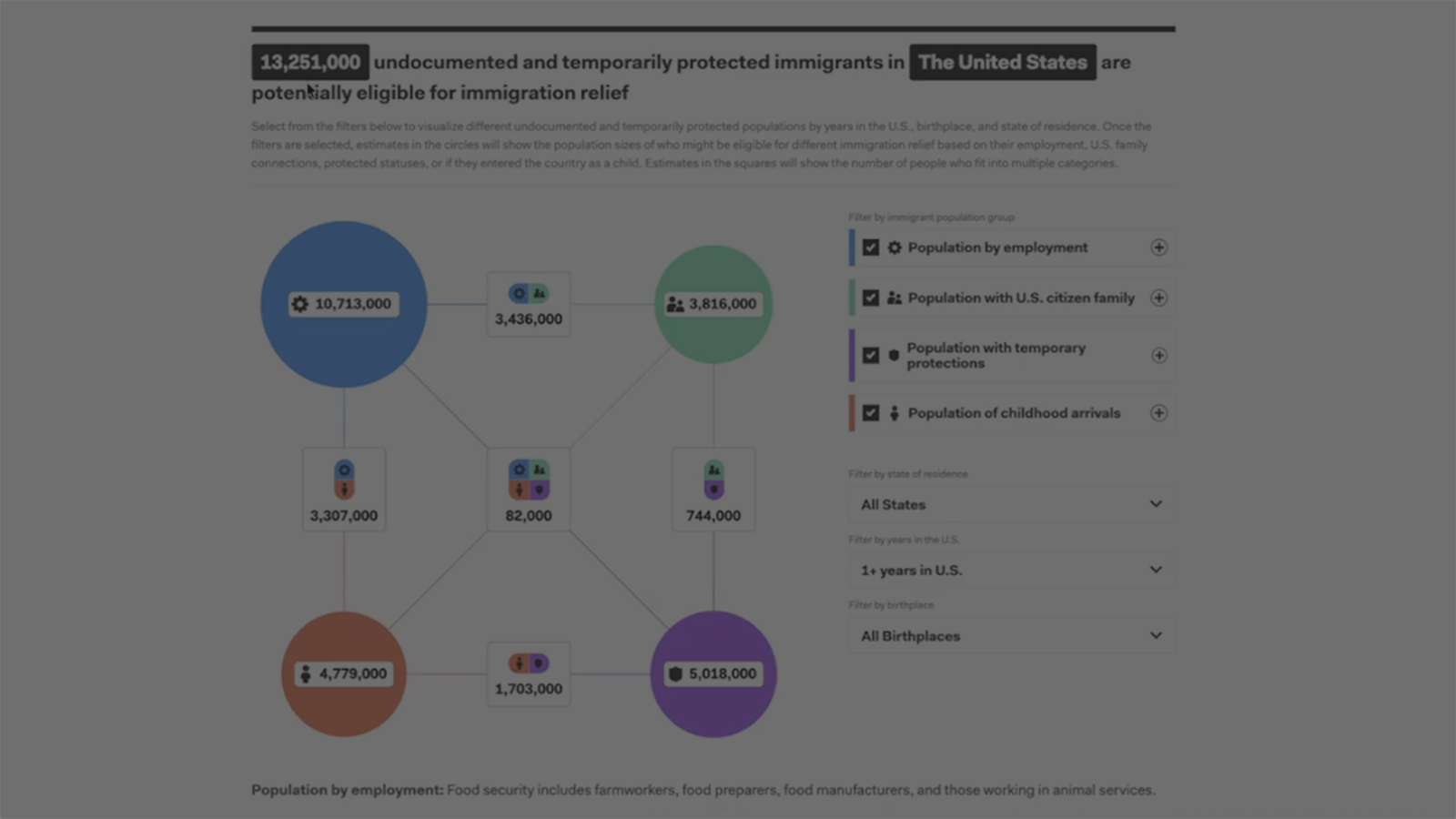
Approximately Loading undocumented and temporarily protected immigrants in the United States are potentially eligible for immigration relief

Select from the filters below to visualize different undocumented and temporarily protected populations by years in the U.S., birthplace, and state of residence. Once the filters are selected, estimates in the circles will show the population sizes of who might be eligible for different immigration relief based on their employment, direct U.S. family connections, protected statuses, or if they entered the country as a child. Estimates in the squares will show the number of people who fit into multiple categories.

Filter by immigrant population group

Potential Workforce pathways for
< 1,000
Potential Family pathways for
< 1,000
Potential Protected pathways for
< 1,000
Potential Child arrival pathways for
< 1,000
There has been an error. Please try reloading the page.

Population by employment: Food security includes farmworkers, food preparers, food manufacturers, and those working in animal services. Housing includes construction workers, housing managers, lodging staff, and building maintenance staff. Care economy includes physicians, nurses, health technicians, health support workers, personal care workers, and child and senior care workers. Other workers are employed in all other occupations not represented by the other three groups of workers and their families.

Population with U.S. citizen family: Minor children are less than 21 years old as of 2024. Adult children are 21 years or older. Because of immigration benefits eligibility, “minority” is set for 21 rather than 18. 

Population with temporary protections: People seeking asylum include individuals with affirmative applications at an asylum office and those seeking asylum before an immigration judge. This may include other asylum-based relief to include withholding of removal. Pending U and T status applicants (including undocumented children and spouses) and those waiting for a visa number after application approval. Special Immigrant Juvenile (SIJ) status applicants include individuals with a pending application and those with an approved application waiting for a visa number. Temporary Protected Status (TPS) holders represent individuals from 17 different countries with current TPS status as of September 30, 2024. Paroled individuals include those paroled through the CBP One application, the Uniting for Ukraine (U4U) and Afghan Allies programs, and the Cuba, Haiti, Nicaragua, and Venezuela (CHNV) parole programs as of September 30, 2024.

Population of childhood arrivals: Childhood arrivals are those who entered the U.S. before they were 18 and include beneficiaries of Deferred Action for Childhood Arrivals (DACA) as well as those who do not qualify for DACA. DACA is the 2012 policy for individuals who arrived in the U.S. as children and met certain eligibility criteria. Most of the individuals who do not meet the DACA eligibility criteria arrived after the DACA cutoff date of 2007.

Source: FWD.us estimates are based on the 2023 American Community Survey, projected to September 30, 2024. See methodology (fwd.us/acs-methodology) for more information.

Temporary Protections

Undocumented immigrants and individuals with temporary protections play a vital role in the U.S. workforce. Many work in sectors facing chronic labor shortages, including agriculture, hospitality, construction, and caregiving. Because temporary statuses often grant work authorization while undocumented status does not, individuals’ ability to access stable employment varies widely, creating a patchwork of vulnerability and opportunity.


As an example, the U.S. care economy is especially dependent on immigrant labor, including a large share of undocumented workers and those with TPS or parole who possess work authorization. Care jobs, such as home health aides, personal care assistants, and childcare providers, often lack clear workforce pipelines and suffer from low wages and high burnout, making them difficult to fill domestically. For many immigrants with temporary protections, caregiving offers one of the most accessible employment opportunities, yet undocumented caregivers often face exploitation due to the absence of formal labor protections. Some 380,000 care workers, along with an additional 115,000 undocumented or temporarily protected spouses and children, currently contribute to the U.S. economy. 

Several legislative proposals have sought to regularize the status of immigrant workers in essential industries. The Dignity Act (2023) proposes earned legal status and renewable work authorization for long-term undocumented workers, many of whom staff the care economy. The American Dream and Promise Act includes pathways to residency for TPS holders, enabling stability for care workers who rely on temporary protections. Previous proposals—such as efforts to create or expand visa programs for healthcare and direct-care workers—reflect ongoing recognition of workforce needs, though none have created a permanent immigration channel for caregivers. 

Congress could also create new visa pathways, like a Caregiver Visa, to ensure that immigrants are able to work in industries where there are not enough native-born workers to fill labor needs. For example, as the U.S. population ages, there will be a significant need to increase the caregiver labor workforce for eldercare, especially in residential care facilities. Similarly, as states seek to encourage families to grow, greater access to childcare will become necessary. The new visa can be temporary, with an eventual option for workers to seek citizenship if they meet certain requirements.


Childhood Arrivals

Childhood arrivals include undocumented young people brought to the U.S. as minors, many of whom have lived in the country nearly their entire lives. While the Deferred Action for Childhood Arrivals (DACA) program, created in 2012, offered temporary protections and work authorization for some, its strict entry-date and age requirements leave out the majority of undocumented youth. DACA provides no pathway to permanent residency and has been limited by court rulings. In all, nearly 4.8 million undocumented and temporarily protected youth and young adults continue to live in legal limbo. 

Undocumented and temporarily protected immigrants in the United States who entered as children

There has been an error. Please try reloading the page.

Note: Estimates rounded to thousands. DACA – Deferred Action for Childhood Arrivals. 

Source: FWD.us estimates based on the 2023 American Community Survey, projected to September 30, 2024. See methodology for more information.

Many childhood arrivals are entirely ineligible for DACA due to missing the 2007 entry cutoff, lacking documentation, or aging out of eligibility. This population is nearly 3.8 million. Some hold temporary protections such as U visas, T visas, or humanitarian parole, but still lack a permanent pathway. These DACA-ineligible youth cannot legally work (unless granted work authorization under a temporary protection) and face significant barriers to obtaining higher education, driver’s licenses, and professional licensing. Despite long-term residence, they remain among the most vulnerable immigrant young people in the United States.

Over two decades of legislative efforts have attempted to protect childhood arrivals, especially those excluded from DACA. The Dream Act, introduced repeatedly since 2001, would provide conditional residency and a pathway to citizenship for long-term undocumented youth. The American Dream and Promise Act includes protections for DACA-eligible and DACA-ineligible youth, including those with TPS or similar temporary statuses. The Dignity Act also proposes a multistep legalization process applicable to undocumented youth lacking other options. Congress has not yet passed a permanent solution, leaving many young people dependent on unstable or temporary protections.


Mixed-status Families

Mixed-status families—those with members who are a mix of U.S. citizens, undocumented individuals, and/or temporary-status holders—are widespread in the United States. These families often face uncertainty due to barriers to adjusting immigration status, the risk of detention or deportation, and the limits of temporary protections such as U visas, T visas, TPS, or humanitarian parole. Many households endure financial and emotional strain as complex immigration rules shape their everyday decisions. In all, nearly 9.7 million U.S. citizen family members live with one or more undocumented or temporarily protected immigrants.

U.S. citizens living with undocumented and temporarily protected immigrants in the United States

There has been an error. Please try reloading the page.

Note: Estimates are rounded to thousands. Children are those of any age living with undocumented parents, including adult children.

Source: FWD.us estimates based on the 2023 American Community Survey, projected to September 30, 2024. See methodology for more information.

For example, U.S.-citizen spouses, who number over 1.2 million, frequently encounter barriers when sponsoring partners who are undocumented or who hold temporary statuses without a direct pathway to permanent residency. Undocumented spouses who entered without authorization cannot get status through their marriage without leaving the U.S., but a departure will trigger 3- and 10-year reentry bars, forcing long-term separations. 

Multiple legislative proposals have aimed to reduce family separation and create stability for mixed-status families; tragically, the last administration’s Keeping Families Together parole policy was blocked in the courts and then abandoned by the current administration. The American Families United Act seeks to expand waiver eligibility for undocumented spouses of U.S. citizens. The Dignity Act proposes legalization pathways that would directly benefit undocumented spouses. For temporary protection holders, the American Dream and Promise Act would provide a pathway to permanent residency for TPS recipients and for noncitizens with certain humanitarian statuses. Additional proposals—including reforms to U and T visa processing—have attempted to reduce backlogs and allow family unity, though none have fully resolved barriers to adjustment. Congress could also move to eliminate the 3- and 10-year reentry bars to allow more people to adjust their status. 


Workforce Participation

Undocumented immigrants and individuals with temporary protections play a vital role in the U.S. workforce. Many work in sectors facing chronic labor shortages, including agriculture, hospitality, construction, and caregiving. In all, nearly 11 million undocumented or temporarily protected individuals are in the U.S. workforce or are married or a child of an employed undocumented or temporarily protected individual. Because temporary statuses often grant work authorization while undocumented status does not, individuals’ ability to access stable employment varies widely, creating a patchwork of vulnerability and opportunity.

Undocumented and temporarily protected immigrant population by occupation in the United States

There has been an error. Please try reloading the page.

Note: Food security includes farmworkers, food preparers, food manufacturers, and those working in animal services. Housing includes construction workers, housing managers, lodging staff, and building maintenance staff. Care economy includes physicians, nurses, health technicians, health support workers, personal care workers, and child and senior care workers. Children are less than 21 years old as of 2024.

Source: FWD.us estimates based on the 2023 American Community Survey, projected to September 30, 2024. See methodology for more information.

As an example, the U.S. care economy is especially dependent on immigrant labor, including a large share of undocumented workers and those with TPS or parole who possess work authorization. Care jobs, such as home health aides, personal care assistants, and childcare providers, often lack clear workforce pipelines and suffer from low wages and high burnout, making them difficult to fill domestically. For many immigrants with temporary protections, caregiving offers one of the most accessible employment opportunities, while undocumented caregivers often face exploitation due to the absence of formal labor protections. Some 380,000care workers, along with an additional 115,000 undocumented or temporarily protected spouses and children of care workers, currently contribute to the US economy. 

Several legislative proposals have sought to regularize the status of immigrant workers in essential industries. The Dignity Act (2023) proposes earned legal status and renewable work authorization for long-term undocumented workers, many of whom staff the care economy. The American Dream and Promise Act includes pathways to residency for TPS holders, enabling stability for care workers who rely on temporary protections. Previous proposals—such as efforts to create or expand visa programs for healthcare and direct-care workers—reflect ongoing recognition of workforce needs, though none have created a permanent immigration channel for caregivers. 

Congress could also create new visa pathways, like a Caregiver Visa, or other sector-specific pieces of legislation, to ensure that immigrants can work in industries where there are not enough native-born workers to fill labor needs. For example, as the U.S. population ages, there will be a significant need to increase the caregiver labor workforce for eldercare, especially in residential care facilities. Similarly, as states seek to encourage families to grow, greater access to childcare will become necessary. The new visa can be temporary, with an eventual option for workers to seek citizenship if they meet certain requirements. 

Prior administrations have taken critical, although limited, steps forward to protect immigrants in the workforce, including the Deferred Action for Labor Enforcement (DALE) program. Future administrations should explore options to expand protections to those contributing to our economy.


Contributors

Phillip Connor, Deborah Fleischaker, Andrea Flores, Kenzi Hilario, Scott Levy, Claire McNulty, Royce Murray, Ali Procopio

Tell the world; share this article via...