Loading...
April 29, 2025
Just a Minute
on Protests and Public Safety
Bad premises beget worse policies. Spend just a minute with us so that we can do better.
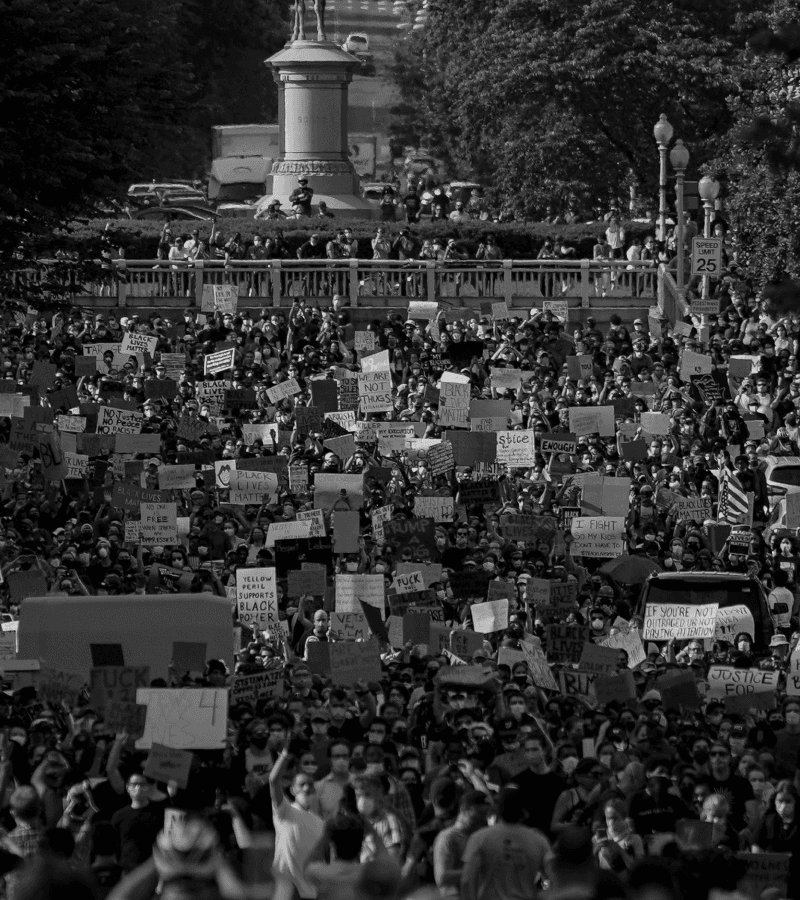
Over the last 15 years, continuing through this month, unprecedented numbers of people across the world have taken to the streets to make their voices heard. The summer of 2020 marked the height of this upswing in the United States when millions participated in protests against police violence following the murder of George Floyd.
You’ll remember that much of the backlash to these protests was based on arguments about how they undermined public safety. One of the baldest theories, and where the record really scratched for us, was that these protests had somehow contributed to the tragic nationwide surge in homicides in 2020. Blaming the overwhelmingly peaceful protests for spikes in murder spread through academic hypotheses, mainstream media, and political discourse largely unchecked. That myth has since been repeatedly disproved, but we noticed that the correction hasn’t exactly been shouted from the rooftops by the folks who got it wrong to begin with. It’s one of many clumsy or mal-intended theories on protest and public safety that still impact our policymaking, paving the way for an uptick in enforcement and an increase in laws criminalizing protest across the country.
Right now, protesters at town halls are being subdued with stun guns, participation in protests is leading to detention and possible deportation, and protesters in Atlanta are facing federal racketeering charges. Leading into the historically protest-heavy May Day, we’re hoping you keep in mind these important points about the connections between protest, public safety, and criminalization.
Let's Back Up
1. The George Floyd uprisings did not drive the 2020 surge in homicides
In 2020, the United States experienced three co-occurring seismic events: the COVID-19 pandemic, the murder of George Floyd and the mass mobilizations that followed, and a national spike in gun homicides. In the deluge of cultural and political commentary trying to make sense of that turbulent time, a nasty myth gained traction attributing the spike in homicides, at least in part, to the protests. Media outlets ranging from Fox News to the New York Times ran pieces that drew connections between the protests and the increase in homicides. Elected officials followed suit. Even some researchers and academics gave credence to the idea that protests calling for police accountability drove the tragic surge in homicides.
That connection has since been thoroughly and repeatedly debunked. With the benefit of years of data and trends now available, we have a much clearer sense of what caused that homicide spike in 2020 and it was not the protests. For one thing, the timing and geography just don’t add up. The surge happened across the country, in states with large protest movements and those without, in urban and rural areas, and it started about six weeks before George Floyd’s murder.
So what drove this surge? The early pandemic period brought a sharp increase in unemployment, disengagement from school, and increased access to guns due to record gun sales. This happened alongside the rapid cessation of local government and non-profit services, which strong evidence suggests was key to the spike in violence. Homicides remained high into 2021 and 2022 as the ripple effects of the pandemic and these shutdowns continued, and began to fall rapidly in 2023 and 2024 as services and community engagement returned. Recently, Brookings researchers dove deep into precisely this question of what caused the homicide increase and whether protests contributed. They came to a clear conclusion that it was driven by factors related to the pandemic responses that pushed some of the most at-risk groups—teen boys and young men in areas of concentrated poverty—out of school and out of work.
These findings are consistent with a large body of research finding that investments in social services, community infrastructure improvements such as blight abatement, and targeted gun violence interventions are effective at reducing crime and violence.
2. We have it backward: criminalizing protest is the real public safety threat
Ironically, the unfounded idea that protest and protesters make us less safe continues to pave the way for a proliferation of laws that do make protesters markedly less safe by exposing them to jail, prison, deportation, and both police and vigilante violence.
The number of laws criminalizing protest has risen dramatically in the past decade. Since 2017, 21 states have successfully enacted a total of 51 different limitations on protests. Notably, the number of anti-protest laws enacted has doubled since 2021, the year following the George Floyd uprisings.
Many of these new laws broadly restrict where people can gather, expand definitions of what constitutes a “riot,” and enact harsh penalties for demonstrators. In Iowa, for example, legislators increased penalties for obstructing sidewalks to two years in jail. Louisiana lawmakers altered the state’s RICO statute, exposing protesters to up to 50 years in prison with hard labor. In addition, several states have passed legislation making individuals who participate in protest or activism eligible for domestic terrorism charges.
The stated intent of these laws? That they protect “public peace” or hold “those who incite violence in our communities accountable.” Yet many of the same state legislatures enacting anti-protest laws are simultaneously enacting legislation that grants immunity to individuals driving their cars into protests, and many of the District Attorneys prosecuting protesters are choosing not to bring charges against people accused of violently attacking them. A Boston Globe analysis found that less than half of incidents involving vehicular violence against protesters are prosecuted.
3. Black, brown, and immigrant protesters face higher risks of criminalization
Protest events with Black participants are more likely to draw police presence and police are more likely to take action. News organizations across the country found racially disproportionate arrest and felony charging rates throughout the 2020 racial justice uprisings. Police were also 3.8x more likely to use projectiles and chemical weapons in racial justice protests in 2020, compared to other protests at the time, including gatherings of armed protesters opposing COVID-19 pandemic restrictions.
Protest participation has particularly stark consequences for non-citizens, with international students and scholars facing repercussions from visa revocations to deportation, and legal permanent residents fighting deportation due to campus protests.
Continue the Conversation
Read
- “Why did U.S. homicides spike in 2020 and then decline rapidly in 2023 and 2024?” by Rohit Acharya and Rhett Morris
Track
- Protests and demonstrations in the U.S. with the Crowd Counting Consortium, and state and federal anti-protest legislation using the International Center for Not-for-Profit Law’s U.S. Protest Law Tracker.

We can’t afford to scale up, export, or leave unchecked what we’ve already gotten wrong. We’ll be using this note to unpack the faulty thinking about crime, safety, and justice that underpins some of the most consequential discussions and decisions playing out in this American moment. You can find our previous notes here.


Subscribe to the newsletter
Loading...