Loading...
June 27, 2025
Just a Minute
on Criminalizing Homelessness
Bad premises beget worse policies. Spend just a minute with us so that we can do better.
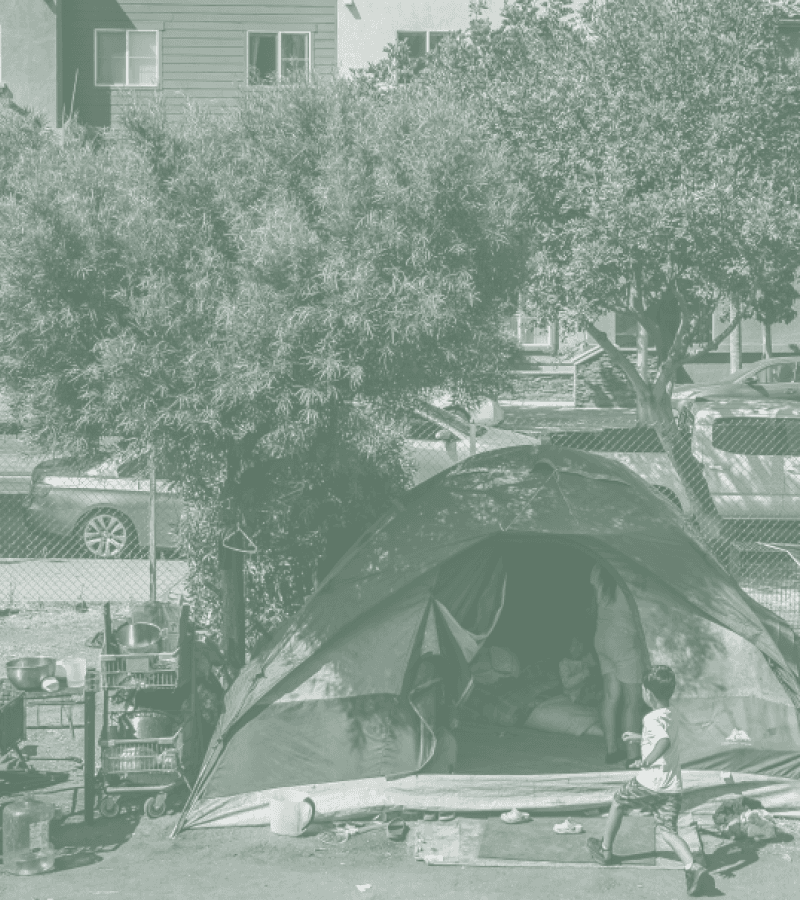
It’s been a year since the Supreme Court’s Grants Pass v. Johnson decision gave cities more power to punish people for sleeping outside. Since then, both homelessness and its criminalization have surged. From Trump to Newsom, leaders across party lines are backing harsher crackdowns—including zero-tolerance policies and sweeps of encampments.
The language of “sweeps” and “clearings” may conjure images of thriving public spaces. But in practice, they often leave unhoused people with no good alternatives of where to live, destroy what little they own, and bring in police to enforce it all through the threat of arrests and citations. A San Francisco crackdown on encampments led to over 700 arrests for “illegal lodging” in just eight months—compared to only nine the year before. In short, sweeps = indirect criminalization.
The record first scratched for us when we noticed that elected officials across both parties were backing sweeps just as homelessness reached record highs, housing costs continued to soar, and cuts to federal housing assistance programs, Job Corps, and social safety net programs like Medicaid will almost certainly force millions more into financial precarity.
So on this Grants Pass anniversary, spend just a minute with us catching up on who’s unhoused, why, and what the evidence really says about homelessness, criminalization, and public safety.
Let's Back Up
Homelessness is exploding…and aging.
Last year, U.S. homelessness reached a record high of more than 771,000, with an 18% increase in people experiencing homelessness compared to the previous year. Record numbers of people are becoming homeless for the first time, and more unhoused people than ever are over 65. In the past four years alone, the number of seniors experiencing homelessness has grown by 50%. Many of the unhoused are also working people. Just over a third of adults in unhoused families in California reported earning income from a job in the prior month.
Even for Americans who are currently housed, the threat of homelessness looms larger than ever. Nearly half of renters in this country are cost-burdened — spending more than 30% of household income on rent or housing costs. Black households and those headed by elders are even more severely cost burdened, and rents continue to climb. Research shows that in places where rents are higher, homelessness rates tend to be greater too. For instance, a study from the U.S. Government Accountability Office found that a $100 increase in the median rent was associated with a 9% rise in the estimated homelessness rate.
Criminalizing homelessness drives more homelessness.
Everyone wants to feel safe in their community and nobody wants the increases in poverty and homelessness to go unaddressed, least of all the people forced to endure them. But we can t escape the fact that criminalization is a massive driver of, rather than a solution to, homelessness.
People who are unhoused are far more likely to be arrested than housed people with a vast majority of those arrests stemming from minor infractions like loitering or open container violations. Incarceration, in turn, makes people more likely to become unhoused in the future. Formerly incarcerated people are nearly 10 times more likely to experience homelessness than the general public, regardless of whether they had housing prior to their jailing. A striking 79% of California’s unhoused population has experienced incarceration in their lifetime, and 43% of people had spent time in jail, prison, or on probation or parole in the months leading up to homelessness. Even family members of incarcerated people are more likely to fall into homelessness as a result of the hit to household incomes. One in six children of incarcerated parents reported becoming at least temporarily homeless as a result of their parents incarceration. And criminal records make it significantly more challenging to get housing and to get good, stable jobs that could pay for housing.
Sweeps don't reduce crime.
Beyond the cruelty of arresting people for being poor, the efficacy of clearing encampments as a crime reduction strategy is questionable at best.
In Denver, an analysis of the forced displacement of people experiencing homelessness found that they did nothing to reduce citywide crime. And although the displacements did result in some hyperlocal reductions in minor crime, they also produced hyperlocal increases in serious crime. In the Bronx, the forceful closure of a homeless encampment had no effect on crime complaints in the area. And in Los Angeles, an LAPD program that flooded Skid Row with large numbers of police and resulted in numerous arrests of unhoused people failed to produce any better or faster reductions in crime when compared to other parts of the city that were not policed as heavily.
Additionally, the criminalization of homelessness as a public safety strategy completely disregards the safety of unhoused people. Unhoused people are far more likely than the general population to be on the receiving end of a violent crime. Not only do unhoused people experience assault, robbery, and theft at rates 11, 12 and 20 times higher than the general population, they also experience violence at the hands of the police at far greater rates, with 35% of use of-force incidents in Los Angeles involving unhoused people.
Want safety? Start with housing.
The good news is that we already know what works to both reduce crime and reduce homelessness: providing people with long-term and high-quality housing and supportive services. Here are a few examples:
During the 20 years that Miami was under a federal consent decree that largely prevented police from arresting or taking the belongings of unhoused people, the county s homeless population plummeted by 90% due to investment in housing and services.
In Denver, the Supporting Housing Social Impact Bond Initiative s efforts to increase housing and decrease jail stays among people experiencing chronic homelessness and frequent arrests resulted in a 34% reduction in police contacts and a 40% reduction in arrests. Seventy-seven percent of the participants retained housing for three years.
In sprawling Los Angeles County, Housing First assistance reduced the likelihood of a criminal charge by 85% and the likelihood of jailing by 95% in the subsequent 18 months. According to new research by LACAN and Human Rights Watch, providing permanent supportive housing to disabled unhoused people who have been on the streets for over a year results in 90% retention rates after a year.
Less punitive approaches to homelessness are not only more effective, they re also popular. Recent polling finds that 77% of voters believe improving access to resources like housing and mental health and addiction services is key to addressing homelessness, rejecting punitive responses like arrests and forced removal from public spaces.
Continue the Conversation
Read
Human Rights Watch’s report “You Have to Move!” on the criminalization of homelessness in LA. New York Times’s piece on the rising rates of unhoused Baby Boomers.
Follow
Housing not Handcuff’s Threat Tracker which tracks bills that criminalize homelessness.

We can’t afford to scale up, export, or leave unchecked what we’ve already gotten wrong. We’ll be using this note to unpack the faulty thinking about crime, safety, and justice that underpins some of the most consequential discussions and decisions playing out in this American moment.
Tell the world; share this article via...


Subscribe to the newsletter
Loading...