Loading...
November 24, 2025
Just a Minute
on Cell Phones as Contraband
Bad premises beget worse policies. Spend just a minute with us so that we can do better.
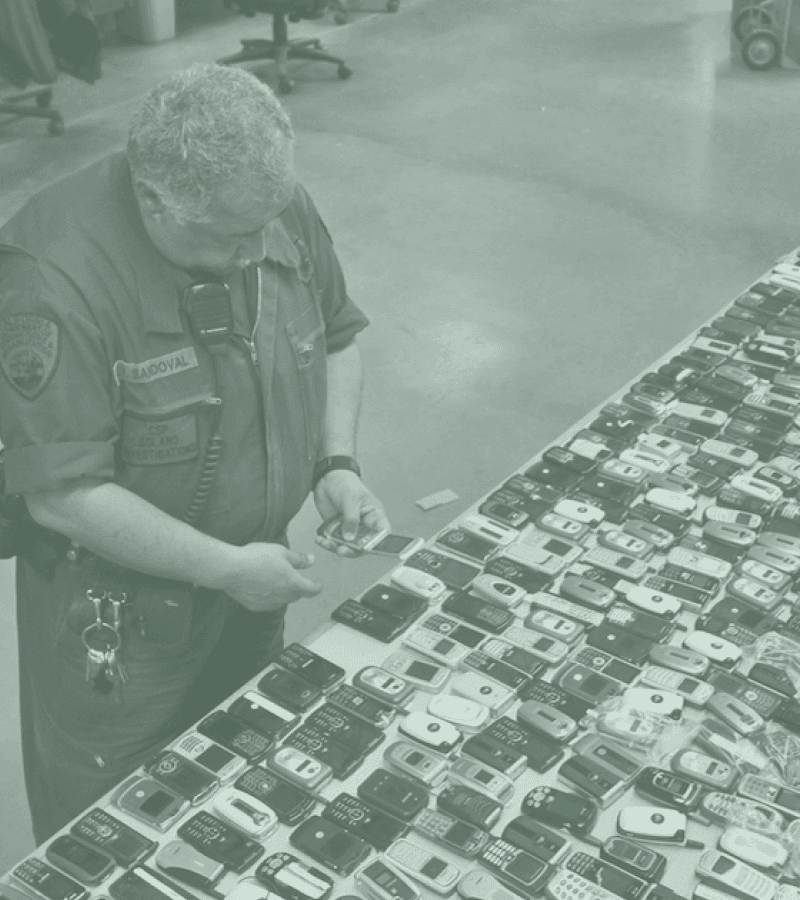
Contraband. It’s a loaded word that quickly leads people to assume that whatever falls under the label must be dangerous and banned for good reason. But like most snap judgments, the real story is more complicated. Right now, policymakers for prisons, jails, and detention centers across the country are wrestling with the tradeoffs of one particular kind of “contraband”: cell phones.
Let's Back Up
Incarcerated people should be able to talk to their family and legal teams on a regular basis. It’s better for them, their families, and leads to better outcomes. Although cell phones are generally banned in prisons and jails, people often turn to contraband cell phones because official communication is prohibitively expensive and inaccessible. Incarcerated people must use designated phones, often in public spaces—and typically pay private companies for the privilege at exorbitantly steep rates. In some facilities, people must spend as much as $16.50 for a 15-minute call, often while working for pennies on the hour.
Concerns about the safety and security threats posed by cell phones in prisons are well documented and widely discussed. But what gets far less attention are the ways they provide a lifeline for incarcerated people and their families, and their critical role in exposing human rights violations in an opaque and often brutal system. You don’t have to dismiss those security concerns to simply weigh them against the benefits of communication and the harms of further criminalizing the use of cell phones.
As detention expands across both the criminal justice and immigration systems, it’s critical to track what’s happening behind bars and have a more rigorous and nuanced conversation about the gap cell phones currently fill in keeping people connected and bringing abuses to light.
So spend just a minute with us on five things you probably didn’t know about communication and cell phones in prisons.
1. It's really hard and expensive to call someone from prison–and about to become more so
The Federal Communications Commission recently advanced two policies that, once enacted, will profoundly reshape prison communication for the worse. One new rule reverses hard-won progress on limiting the profits of the exploitative prison phone industry. After decades of hefty bills for incarcerated people and their loved ones—with an estimated one in three going into debt to afford prison calls and visits—dogged advocacy finally won regulation that capped the exorbitant cost of phone and video calls for incarcerated people. By nearly doubling the price caps on phone and video calls from prisons and jails, the FCC is now stripping families of at least $215 million in expected financial relief each year.
As the price of “lawful” calls from inside is poised to climb, the FCC also opened rulemaking on a proposal to cut off nearly all cell phone communication by allowing prisons to use phone jamming technology. This comes over the objections of incarcerated people and their families, many correctional officers, criminal justice reform advocates, wireless carriers, and freedom of expression organizations.
2. Cell phones can be lifelines
Incarcerated people, like all people, depend on social connections for their mental and physical health and wellbeing. The strictly enforced rules of prison and jail life and the locations of most prisons far from people’s families and communities make prison a particularly isolating place, and people in prison rarely receive visitors. Phone and video calls are critical for maintaining relationships and social connections at a distance. As a result, people risk severe consequences for using contraband cell phones from jail or prison in order to reach their loved ones at a fraction of the price they would pay in predatory per-minute fees to the $1.4 billion prison telecom industry.
A contraband phone let one person in federal prison FaceTime their ailing mother, whose chronic lung disease prevented her from visiting. As they told The Marshall Project: “When she went home with hospice care, I was able to see her and talk to her before she died.” Another spoke of relying on tutorials from the internet to provide critical medical care to a peer, suturing a leg wound and preventing infection using the tools they had on hand: “dental floss, triple-antibiotic ointment and Super Glue.” Many people also use contraband cell phones to speak privately with their lawyers, a necessity for confidential communications since even privileged communications are recorded.
3. One of the most powerful forces exposing prison abuse? Cell phones
The footage people capture on cell phones has revealed life-threatening conditions that would otherwise stay hidden and has become one of the most powerful drivers of transparency and accountability behind bars. HBO’s The Alabama Solution, which premiered at Sundance and was released for streaming last month, has redirected public attention to Alabama’s unconscionable prison conditions and organizing by incarcerated people to change them. But without cell phones in prison, the critically acclaimed film and the galvanizing story it tells could not exist. More than half of its footage was shot by incarcerated people on contraband cell phones, capturing years of institutional violence and abuses the public would otherwise never see in the prisons that codirector Andrew Jarecki says are “treated like black sites” in the U.S.
The impact of cell phone footage in exposing routine violence and neglect goes far beyond Hollywood. In 2022, a video showing a prison guard in Alabama beating an incarcerated man led to the guard’s suspension and resignation. That same year, people inside Alabama prisons used cell phones to record the paltry and often inedible meals they were served, images that later became evidence in federal litigation challenging the state’s prison system.
4. The call is coming from inside the house
Family members of incarcerated people who endure invasive strip searches when they visit prison and jails are frequently scapegoated for the problem of contraband cell phones. However when it comes to all types of contraband and especially cell phones, it’s correction officers themselves often smuggling in and selling the cell phones to incarcerated people. This tracks directly with data that shows the highest rates of contraband smuggling are in states with the lowest salaries for prison guards.
5. Crackdowns aren't doing what you think–and there are other options
Fifteen years after cell phones were officially declared contraband in federal prisons, more phones are inside than ever. A 20-state survey back in 2020 found that more than 25,000 cell phones had been recovered, which was roughly one for every 26 people in those prisons. While crackdowns haven’t worked to eliminate cell phones, the endless random searches of housing units and cells that they require can result in violence and the destruction of incarcerated people’s legitimate belongings. The ban has also fueled a black market, with phones selling for $500 to $5,000, that fuels more violence and corruption inside prisons.
Fortunately, jurisdictions in America and abroad are working to find another way forward. In Argentina, officials began permitting cell phone use in some prisons at the start of the pandemic, and kept the policy going after; at least four provinces now allow the phones. While not going quite as far as Argentina, prisons in the UK and even a jail in South Carolina have adapted their phone policies to provide people a way to make calls from their cells, acknowledging people’s need for privacy and a connection to the outside world.
Continue the Conversation
Watch
- Andrew Jarecki and Charlotte Kaufman’s The Alabama Solution, a 2025 documentary exposing the unconstitutional conditions of Alabama’s deadly prison system using footage captured by residents on contraband cell phones
Follow
- Bianca Tylek, Executive Director of Worth Rises, @BiancaTylek @biancatylek.bsky.social and Keri Blakinger, investigative journalist at ProPublica, @keribla.bsky.social @keribla
Read
- Jeremy Busby’s article on The Latest FCC Censorship Push No One Is Talking About Targets Incarcerated People and Hannah Riley’s take: Just Let People Have Cellphones in Prison
Track
- Congressional Democrats introduced legislation this month to ensure immigrants in detention can call their families and lawyers

We can’t afford to scale up, export, or leave unchecked what we’ve already gotten wrong. We’ll be using this note to unpack the faulty thinking about crime, safety, and justice that underpins some of the most consequential discussions and decisions playing out in this American moment. You can find our previous notes here.
Subscribe to the newsletter
Loading...