Leaders from Georgia's business and legal communities joined FWD.us and the Georgia Chamber of Commerce in Atlanta to discuss immigrants' vital role in the state's economy and the need to preserve protections
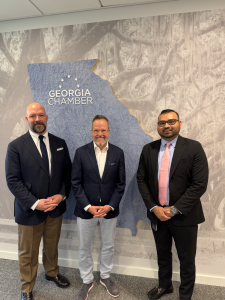
Atlanta, GA – Today, FWD.us and the Georgia Chamber of Commerce co-hosted a roundtable event bringing together Georgia business leaders and workforce experts to discuss the role that immigrants play in Georgia and the importance of preserving their existing protections, as part of FWD.us' Protect America's Workforce campaign. The event included a state of play update from FWD.us, a legal landscape overview, an open forum on potential policy solutions, and a Q&A with Chris Clark, President & CEO of the Georgia Chamber of Commerce.
The conversation also examined how labor shortages are affecting key Georgia industries – including agriculture, health care, construction, and food services – and the critical role immigrants play in filling those gaps. Nationwide, American families are expected to see a $2,150 annual increase in everyday goods and services under newly proposed immigration policies. In Georgia, this means the economy could lose up to $7.3 billion each year, in addition to an estimated $901 million in lost state and local taxes contributed by workers lost.
Participants also looked ahead to what Georgia-led immigration solutions could look like, examining how the state's business community and policymakers can work together to both protect the American workforce and expand opportunity for the immigrants Georgia's economy depends on. Georgia has built one of the most competitive economies in the country, and participants agreed that maintaining that edge requires immigration policies that reflect the state's real workforce needs.
Below are what participants had to say during the discussion:
Chris Clark, President and CEO, Georgia Chamber of Commerce, said: “For generations, the economic success of Georgia and the United States has depended on a strong workforce development effort to prepare Georgians for careers of the future and a functioning immigration system that welcomes talented, innovative, and hardworking people from around the world to help drive prosperity. Today, that system is outdated and unresponsive to the needs of Georgia’s economy. We’ve heard loud and clear that without meaningful reform to the United States’ visa program, Georgia’s employers ranging from agriculture to healthcare to construction and advanced manufacturing will continue to struggle to fill critical roles. The Georgia Chamber and Georgia Chamber Foundation are committed to working with our partners through our Global Talent Initiative, Georgia’s congressional delegation, and the Trump Administration to drive actionable solutions to increase prosperity and grow our economy.”
Mark Delich, Vice President of Government Relations, FWD.us, said: “Immigration isn’t just an abstract policy issue. Its impact is felt across all of our communities. It affects the farmers harvesting crops in South Georgia, the caregivers in Georgia hospitals, the small business owners creating jobs in Atlanta, and beyond. Our goal must be to build immigration policies that reflect Georgia’s workforce reality, support long‑term economic growth, and ensure that all people who want to contribute to this state’s success have a pathway to do so.”
Jaime Rangel, Regional Government Relations Director, FWD.us, said: “Today's roundtable demonstrated that Georgia's business community understands that immigration policy directly impacts their bottom line and their ability to grow. When we lose workforce protections, we lose economic vitality. The conversations we had here show that Georgia's leaders are ready to embrace practical solutions that keep our state competitive while upholding our values.”
ADDITIONAL BACKGROUND
Key data points from the Protect America’s Workforce campaign include:
- Canceling or restricting legal work permits for those with TPS and other protected statuses, including asylum seekers, would sideline millions of workers. TPS holders alone contribute approximately $29 billion annually to the U.S. economy and pay $7.8 billion in combined federal, state, and local taxes.
- Some 450,000 DACA recipients participate in the labor force, contributing nearly $16 billion to the U.S. economy each year.
- FWD.us estimates that undocumented immigrants earning U.S. citizenship would annually contribute an additional $149 billion after taxes to the economy. This could result in a potential annual increase of $39 billion more in combined federal, state, and local taxes.
- Ending automatic Work Authorization Extensions (EAD) will cost billions, with U.S. employers having already saved $3.5 billion in labor turnover costs from the automatic extensions.
- Growing legal pathways for lawful immigration will meet economic and workforce needs for the future.